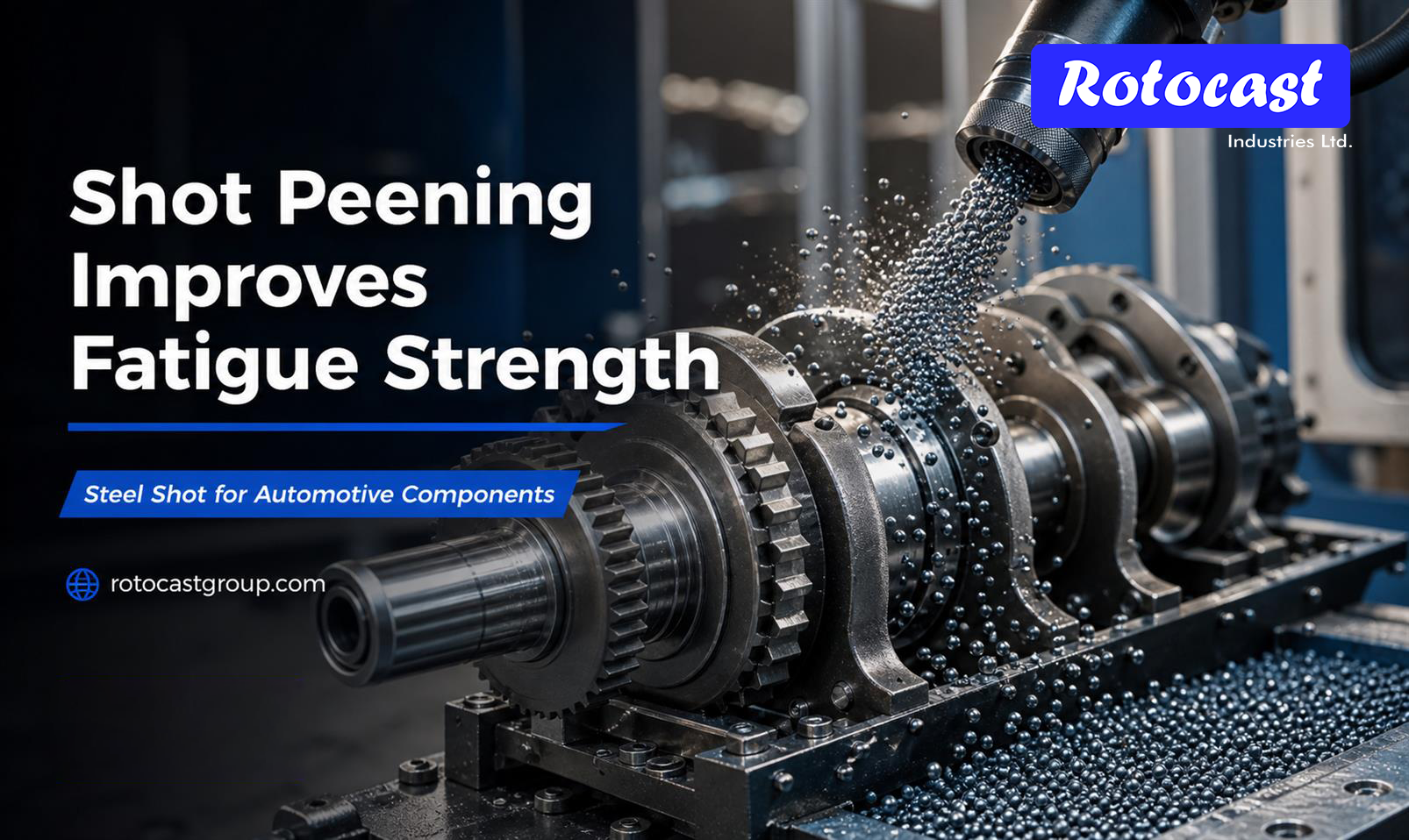
What This Article Covers
- What is shot peening?
- Why fatigue strength matters in automotive manufacturing
- How Steel Shot improves component life
- Science behind compressive residual stress
- Step-by-step shot peening process
- Selecting the correct Steel Shot
- Comparison of Steel Shot vs Cut Wire Shot
- Industry standards and specifications
- Common automotive applications
- Best practices for consistent peening quality
Steel Shot India for Shot Peening: Improving Fatigue Strength of Automotive Components
The automotive industry is constantly striving to manufacture lighter, stronger, and longer-lasting components. Whether it is a suspension spring, crankshaft, connecting rod, transmission gear, axle shaft, or coil spring, every component experiences millions of loading cycles throughout its service life.
Even a perfectly machined steel component can develop microscopic surface cracks due to repeated tensile stress. Over time, these cracks propagate, eventually leading to fatigue failure—one of the most common reasons for unexpected component breakdowns.
This is where shot peening plays a vital role.
Unlike shot blasting, which primarily focuses on cleaning or surface preparation, shot peening is a precision surface enhancement process that deliberately introduces beneficial compressive residual stresses into the component surface. These compressive stresses significantly delay crack initiation and slow crack propagation, improving fatigue resistance without altering the component’s geometry.
For manufacturers across India, selecting the right Steel Shot India supplier is therefore not simply a purchasing decision—it directly influences process consistency, component performance, and production economics.
What is Steel Shot for Shot Peening?
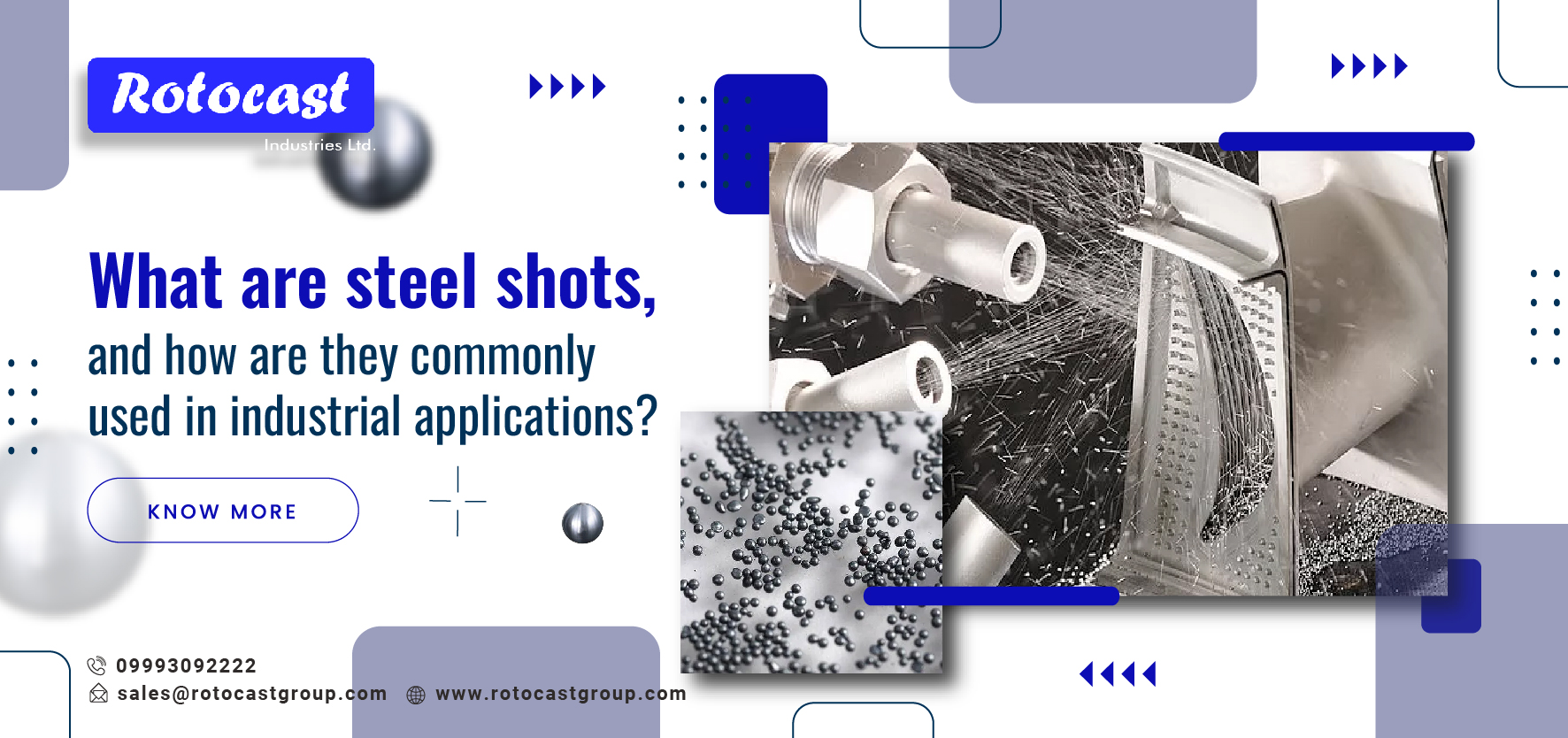
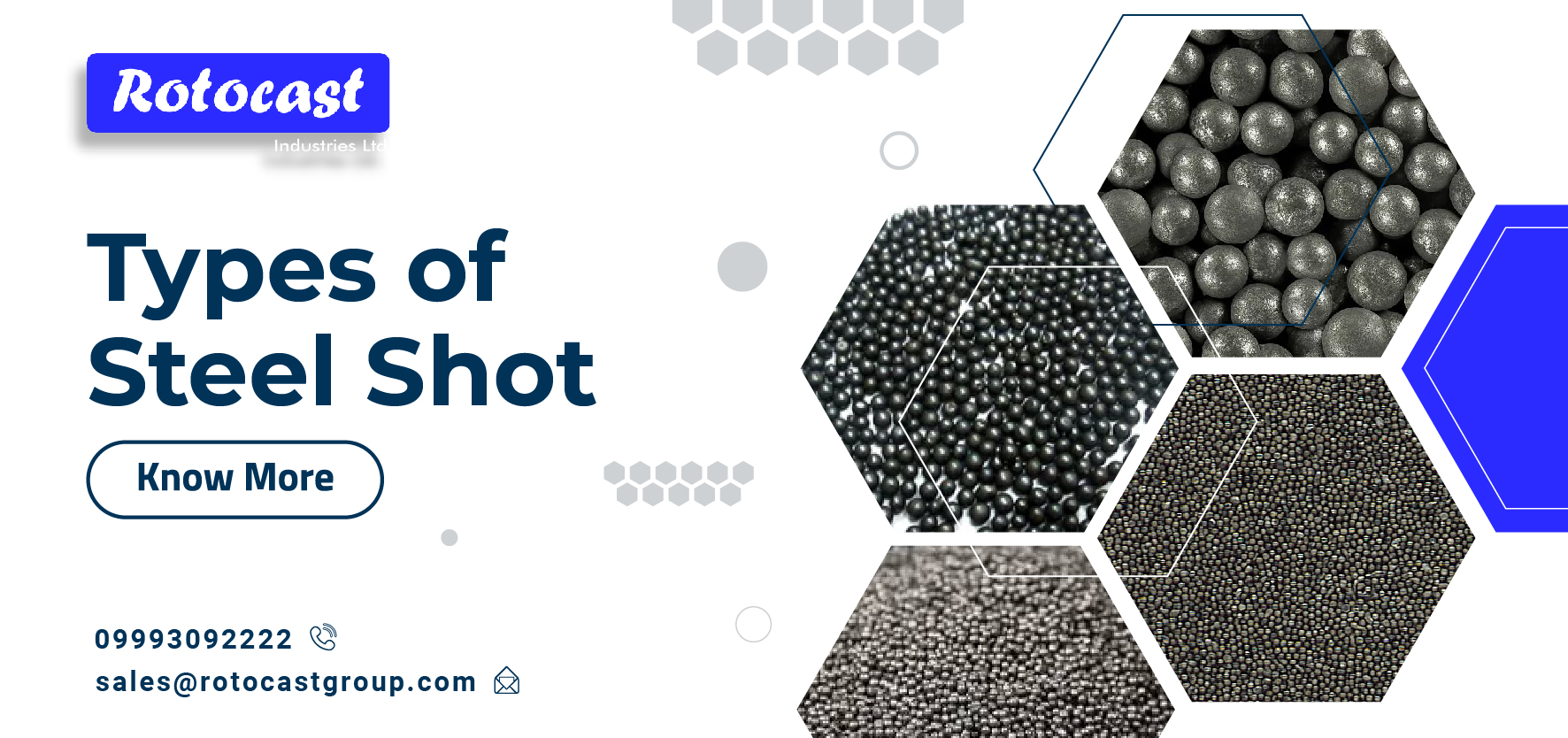
Steel Shot for shot peening is a high-hardness spherical steel abrasive projected at controlled velocity onto a metal surface to create compressive residual stress, improving fatigue strength, crack resistance, and component life without removing significant material.
This controlled cold-working process is widely used in:
- Automotive manufacturing
- Aerospace
- Railway components
- Heavy engineering
- Defence equipment
- Industrial springs
- Forged components
- Transmission systems
Unlike abrasive blasting, the objective is not material removal, but controlled plastic deformation of the surface.
Why Fatigue Failure Remains a Major Challenge in Automotive Manufacturing
Modern vehicles are expected to be:
- Lighter
- More fuel efficient
- Capable of carrying higher loads
- More durable
- Safer under dynamic conditions
This means individual components often operate closer to their design limits than ever before.
Common fatigue-prone automotive components include:
| Component | Typical Failure Mechanism |
|---|---|
| Coil Springs | Cyclic bending fatigue |
| Leaf Springs | Surface crack initiation |
| Gear Teeth | Contact fatigue |
| Crankshafts | Torsional fatigue |
| Connecting Rods | Tensile fatigue |
| Axle Shafts | Rotational fatigue |
| Differential Gears | Surface pitting |
| Valve Springs | High-cycle fatigue |
| Transmission Components | Repeated stress loading |
Many failures originate from microscopic surface imperfections that gradually grow under repeated cyclic loading.
Proper shot peening dramatically delays this process.
Why Shot Peening Works Better Than Simply Using Stronger Steel
A common misconception is that selecting a stronger steel grade automatically results in longer component life.
In reality, fatigue failures almost always begin at the surface—not within the core material.
Increasing tensile strength alone cannot eliminate:
- Surface micro-cracks
- Machining marks
- Grinding burns
- Stress concentration points
- Surface inclusions
Shot peening addresses these issues by modifying the stress profile of the component rather than changing its chemistry.
This makes it one of the highest-return manufacturing processes in automotive production.
The Science Behind Shot Peening
Surface Compression Instead of Surface Removal
When spherical Steel Shots strike the component surface at controlled velocity, each impact behaves like a tiny ball-peen hammer.
Millions of controlled impacts create:
- Small plastic indentations
- Uniform surface deformation
- Beneficial compressive residual stress
- Improved resistance to crack formation
Instead of allowing tensile stress to initiate cracks, the compressive layer suppresses crack growth.
The result is a component capable of surviving significantly more stress cycles before failure.
Understanding Compressive Residual Stress
Imagine bending a paper clip repeatedly.
Eventually it breaks because tensile stress keeps opening microscopic cracks.
Now imagine trying to open a crack while someone is constantly pushing it closed.
That is essentially what compressive residual stress accomplishes.
It creates a protective stress layer that works against fatigue crack propagation.
Benefits include:
- Longer fatigue life
- Improved wear resistance
- Better stress corrosion resistance
- Increased impact resistance
- Reduced maintenance frequency
- Greater component reliability
How Shot Peening Improves Fatigue Strength
The improvement occurs through multiple mechanisms working together.
1. Delays Crack Initiation
Surface imperfections experience lower effective tensile stress.
2. Slows Crack Growth
Any micro-crack that begins growing must first overcome the compressive stress layer.
3. Reduces Stress Concentration
The surface becomes mechanically conditioned against cyclic loading.
4. Improves Load Distribution
Residual compressive stress redistributes operational loads more evenly.
5. Enhances Surface Integrity
Controlled peening produces a more robust working surface capable of handling repeated impacts.
Step-by-Step Shot Peening Process
Successful shot peening requires much more than simply selecting the correct abrasive.
A controlled process typically includes:
Step 1 – Component Inspection
Engineers verify:
- Material grade
- Heat treatment
- Surface finish
- Critical stress locations
- Geometry
Step 2 – Steel Shot Selection
Selection depends on:
- Component hardness
- Desired Almen intensity
- Coverage requirement
- Machine type
- Surface finish requirement
- SAE specification
Step 3 – Machine Calibration
Critical parameters include:
- Wheel speed
- Air pressure
- Flow rate
- Exposure time
- Nozzle angle
- Distance
Step 4 – Controlled Peening
The machine projects Steel Shot uniformly over the target surface.
Uniform exposure ensures consistent compressive stress.
Step 5 – Coverage Verification
Coverage is typically evaluated to ensure:
- 100% surface coverage
- Uniform peening pattern
- No shadow zones
- No over-peening
Step 6 – Almen Strip Verification
Almen strips confirm process intensity.
They ensure every production batch receives consistent energy input.
Key Process Parameters That Control Shot Peening Quality
| Parameter | Why It Matters | Typical Effect |
|---|---|---|
| Steel Shot Size | Controls impact energy | Larger shot creates deeper compressive layers |
| Shot Hardness | Influences deformation | Harder shot increases intensity but may increase surface roughness |
| Velocity | Determines kinetic energy | Higher velocity raises peening intensity |
| Coverage | Ensures complete treatment | Low coverage leaves untreated stress zones |
| Almen Intensity | Measures peening energy | Critical for process repeatability |
| Shot Shape | Affects stress distribution | Round shots produce more uniform compressive stresses |
| Exposure Time | Controls total impacts | Excessive time may cause over-peening |
Choosing the Right Steel Shot for Automotive Shot Peening
Not every Steel Shot grade is suitable for every automotive application. The ideal media depends on a balance of component material, desired fatigue improvement, machine capability, and process control.
When evaluating Steel Shot India suppliers, engineers typically consider the following factors:
Material Quality
High-quality cast steel with controlled chemical composition ensures consistent hardness, toughness, and predictable performance.
Hardness Range
The shot hardness should complement the workpiece hardness. Excessively hard media can damage softer components, while softer media may not achieve the required peening intensity.
Sphericity
Perfectly spherical Steel Shots produce uniform compressive stresses and reduce the risk of surface defects caused by irregular particle shapes.
Size Distribution
A narrow particle size distribution helps maintain consistent Almen intensity and repeatable results across production batches.
Durability
Long-lasting Steel Shots reduce media breakdown, minimize dust generation, and lower overall abrasive consumption.
Compliance with Standards
Quality manufacturers supply media that aligns with relevant industry standards such as SAE J444, SAE J445, SAE J827, SAE J1993, ISO 11124, BIS, and robust quality management systems like ISO 9001.
Steel Shot vs Cut Wire Shot for Automotive Shot Peening
Choosing between cast Steel Shot and cut wire shot depends on the application, required fatigue performance, process economics, and machine setup.
| Feature | Steel Shot | Cut Wire Shot |
|---|---|---|
| Manufacturing Method | Cast and heat-treated | Cut from drawn wire and conditioned |
| Particle Shape | Spherical | Initially cylindrical, becomes rounded during conditioning |
| Cost | Generally more economical | Higher initial cost |
| Durability | High | Very high |
| Coverage Uniformity | Excellent | Excellent after conditioning |
| Fatigue Improvement | Excellent for most automotive applications | Preferred for critical aerospace and high-performance components |
| Machine Compatibility | Suitable for centrifugal wheel and air-blast systems | Commonly used in precision air-blast peening |
| Typical Applications | Springs, gears, crankshafts, forgings, axles | Aerospace components, precision springs, turbine parts |
For many automotive manufacturers, high-quality Steel Shots India offer an optimal balance between process performance, operational cost, and production efficiency, making them the preferred choice for large-scale shot peening operations.
Automotive Components That Benefit Most from Shot Peening
Shot peening is not applied uniformly across every automotive component. It is typically reserved for parts subjected to repeated cyclic loading, impact, torsional stress, or contact fatigue—where even a small surface crack can lead to premature failure.
Below are some of the most common applications where Steel Shot plays a critical role in improving durability and service life.
| Automotive Component | Primary Stress Type | Benefit of Shot Peening |
|---|---|---|
| Coil Springs | Cyclic Bending | Improves fatigue life and resistance to sagging |
| Leaf Springs | Repeated Flexing | Reduces surface crack formation |
| Crankshafts | Torsional Loading | Enhances fatigue strength around fillets |
| Connecting Rods | Tensile & Compressive Cycles | Increases durability under high engine loads |
| Transmission Gears | Contact Fatigue | Minimizes pitting and surface fatigue |
| Differential Gears | Rolling Contact | Improves wear resistance |
| Axle Shafts | Rotational Fatigue | Extends operational life |
| Steering Components | Dynamic Loading | Reduces fatigue-related failures |
| Suspension Arms | Impact & Vibration | Improves crack resistance |
| Clutch Components | Cyclic Stress | Enhances long-term reliability |
For OEMs and Tier-1 automotive suppliers, shot peening has become a standard manufacturing step rather than an optional finishing process. It improves component reliability while supporting warranty reduction and long-term vehicle performance.
How to Select the Right Steel Shot for Your Shot Peening Process
Selecting the right abrasive involves more than matching particle size. Engineers must consider machine capability, workpiece material, desired fatigue performance, and process repeatability.
Step 1 – Understand the Component Material
Evaluate:
- Material grade
- Heat treatment condition
- Surface hardness
- Required fatigue life
- Critical stress locations
Harder materials generally require harder Steel Shots, while softer materials benefit from controlled peening intensity to avoid excessive deformation.
Step 2 – Determine the Required Almen Intensity
Almen intensity defines the energy transferred during peening.
It depends on:
- Wheel speed
- Air pressure
- Shot size
- Shot hardness
- Exposure time
Maintaining the correct Almen intensity ensures repeatable fatigue performance without over-peening.
Step 3 – Select the Appropriate Shot Size
Different shot sizes create different compressive stress profiles.
| Shot Size | Typical Application |
|---|---|
| Small Steel Shot | Precision gears, thin components |
| Medium Steel Shot | Automotive springs, shafts |
| Large Steel Shot | Heavy forgings and structural parts |
Larger shots produce deeper compressive layers, while smaller shots provide better surface coverage on intricate geometries.
Step 4 – Consider Machine Compatibility
Steel Shot selection should match the equipment being used:
- Centrifugal wheel blast machines
- Air blast systems
- Robotic shot peening cells
- Automated production lines
Incorrect media selection can reduce productivity and increase machine wear.
Step 5 – Evaluate Media Life
Higher-quality Steel Shots maintain:
- Shape retention
- Hardness consistency
- Lower fragmentation
- Reduced dust generation
- Stable blasting performance
This directly affects operating costs and maintenance intervals.
Common Shot Peening Mistakes That Reduce Fatigue Performance
Even high-quality Steel Shot cannot compensate for poor process control. Many performance issues arise from avoidable operational mistakes.
Common Mistakes and Their Impact
| Mistake | What Happens | Best Practice |
|---|---|---|
| Incorrect Shot Size | Inadequate compressive layer or excessive surface roughness | Select size based on component geometry and Almen intensity |
| Excessive Peening Time | Surface damage and over-peening | Follow validated exposure times |
| Low Coverage | Untreated areas remain vulnerable to fatigue | Achieve specified coverage, typically 100% or higher |
| Contaminated Media | Inconsistent surface finish and increased wear | Regularly clean and classify media |
| Worn-Out Steel Shot | Reduced impact energy and inconsistent results | Replace media based on quality monitoring |
| Incorrect Hardness | Insufficient or excessive deformation | Match shot hardness with workpiece material |
| Poor Machine Calibration | Variable peening intensity | Perform routine equipment calibration |
| Ignoring Almen Verification | Loss of process consistency | Verify intensity regularly using Almen strips |
Process discipline is often the difference between predictable fatigue improvement and inconsistent production quality.
Why Steel Shot Quality Matters More Than Initial Purchase Price
Many procurement teams evaluate abrasives primarily on cost per kilogram. However, experienced production engineers understand that the true cost lies in total process efficiency – not simply the purchase price.
Low-quality Steel Shots may result in:
- Higher abrasive consumption
- Increased dust generation
- More frequent media replacement
- Reduced wheel life
- Increased separator load
- Inconsistent surface coverage
- Variable Almen intensity
- Greater component rejection rates
In contrast, premium-quality Steel Shots typically offer:
- Better shape retention
- Longer operational life
- Consistent hardness
- Stable blasting characteristics
- Lower media consumption
- Reduced machine downtime
The focus should always be on cost per processed component, not just the cost of the abrasive itself.
Best Practices for Maintaining Steel Shot Performance
Maintaining media quality is just as important as selecting the right media.
Regular Media Inspection
Inspect for:
- Broken particles
- Oversized contaminants
- Dust accumulation
- Rust contamination
- Foreign material
Maintain Proper Classification
Air wash separators and screens should be adjusted regularly to maintain a consistent working mix.
Poor classification leads to:
- Reduced blasting efficiency
- Uneven peening intensity
- Increased machine wear
Monitor Hardness Consistency
Hardness variation affects:
- Peening intensity
- Surface finish
- Fatigue improvement
- Media life
Routine quality checks help maintain process stability.
Replace Media Before Performance Declines
Waiting until Steel Shot is completely worn out often increases:
- Cycle time
- Energy consumption
- Surface inconsistency
- Maintenance costs
A planned replacement strategy is more economical than reactive maintenance.
The Importance of Standards in Shot Peening
Shot peening is a controlled engineering process, and maintaining consistency requires adherence to internationally recognized standards.
Some of the most widely referenced standards include:
SAE J444
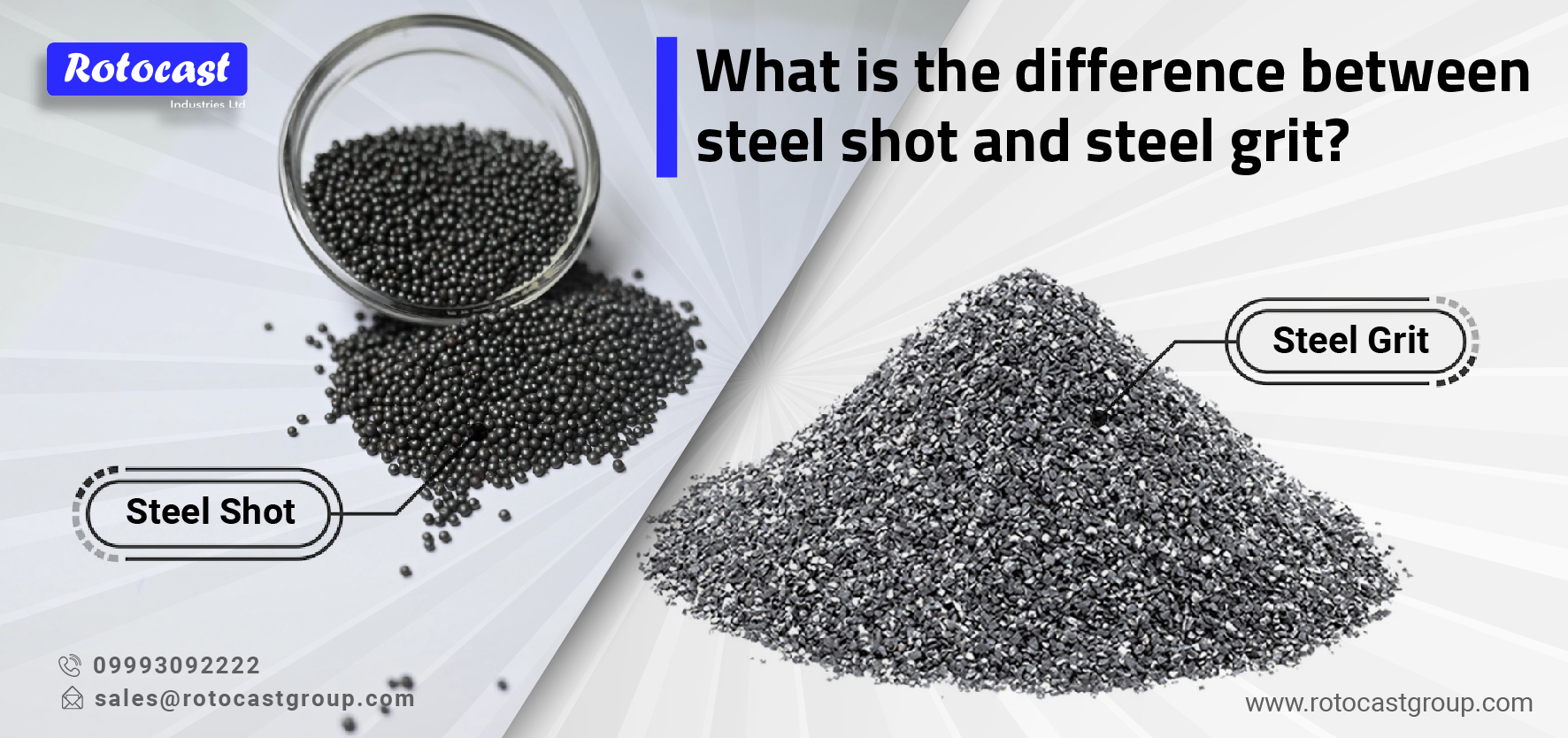
Specifies the chemical composition, hardness, size distribution, and quality requirements for cast Steel Shot and Steel Grit.
SAE J445
Defines procedures for determining shot size through standardized sieve analysis.
SAE J827
Provides guidelines for media classification and quality consistency.
SAE J1993
Focuses on shot peening process control and verification.
ISO 11124
Specifies requirements for metallic blast-cleaning abrasives used in industrial applications.
ISO 9001
Ensures robust quality management systems for manufacturing and process control.
Following these standards helps manufacturers achieve:
- Repeatable surface quality
- Consistent fatigue performance
- Reduced production variability
- Improved customer confidence
- Better audit compliance
Choosing an Experienced Steel Shot Manufacturer in India
For critical applications such as automotive shot peening, supplier capability extends beyond supplying abrasive media.
An experienced Steel Shot Manufacturer should provide:
- Consistent particle size distribution
- Controlled hardness
- High sphericity
- Reliable batch traceability
- Technical application support
- Compliance with relevant ISO, BIS, and SAE standards
Manufacturers working with an experienced Steel Abrasives Manufacturer often experience measurable improvements in media life, process consistency, and overall operational efficiency.
With over 40 years of manufacturing expertise, Rotocast Industries Ltd. has built its reputation by supplying high-quality Steel Shot, Steel Grit, and other steel abrasive solutions to more than 1,000 customers across foundries, automotive, shipbuilding, forging, and heavy engineering industries. Supported by an annual production capacity of 30,000+ tonnes and adherence to internationally recognized quality standards, the company focuses on delivering consistent abrasive performance for demanding industrial applications.
Consistent abrasive quality is not just a specification—it’s the foundation of a defect-free finish, predictable fatigue performance, and longer equipment life.
Frequently Asked Questions (FAQ)
1. What is the purpose of Steel Shot in shot peening?
Steel Shot is used to introduce compressive residual stress into the surface of metal components, improving fatigue strength, delaying crack initiation, and extending the service life of parts subjected to cyclic loading.
2. What is the difference between shot blasting and shot peening?
Shot blasting is primarily used for cleaning, descaling, and surface preparation, while shot peening is a controlled process that enhances mechanical properties by improving fatigue resistance without significant material removal.
3. Which automotive components require shot peening?
Common applications include coil springs, leaf springs, gears, crankshafts, connecting rods, axle shafts, transmission components, steering parts, and suspension systems.
4. How often should Steel Shot be replaced?
Replacement depends on media breakdown, contamination levels, hardness retention, and process consistency. Regular inspection and classification help determine the optimal replacement schedule rather than relying solely on operating hours.
5. How do I choose the right Steel Shot Manufacturer in India?
Look for manufacturers with proven industry experience, consistent product quality, compliance with ISO and SAE standards, reliable technical support, and a strong track record in automotive and industrial applications.
As automotive manufacturers continue to demand lighter, stronger, and more durable components, shot peening remains one of the most effective surface enhancement processes available. When executed with the correct parameters and high-quality Steel Shot, it significantly improves fatigue strength, extends component life, and enhances overall production reliability.
However, successful shot peening depends on more than the machine itself. It requires consistent media quality, proper process control, adherence to recognized standards, and a thorough understanding of application-specific requirements.
With more than 40 years of manufacturing experience, Rotocast Industries Ltd. has earned the trust of 1,000+ industrial customers by delivering dependable Steel Shot, Steel Grit, and steel abrasive solutions backed by a 30,000+ tonnes annual production capacity and compliance with ISO 9001, ISO 11124, BIS, and relevant SAE standards. This expertise enables manufacturers to achieve consistent surface treatment performance while improving operational efficiency and product reliability.