- Rotocast
- Oct 3, 2026
- Blogs, Shot Blasting, Steel Abrasives, Surface Preparation
- 0 Comments
If coating adhesion varies from batch to batch, the problem may not be paint—it may be profile. Steel grit blasting must create the right depth and texture consistently, not simply remove rust. The key is controlling abrasive size, hardness, working mix, equipment energy, and measurement.
What This Article Covers
- What controls blast profile depth and shape
- How grit size, hardness, and velocity interact
- How to select media using a practical decision table
- Which process mistakes distort profile consistency
- Five surface-profile FAQs for plant teams
What is the right surface profile in steel grit blasting?
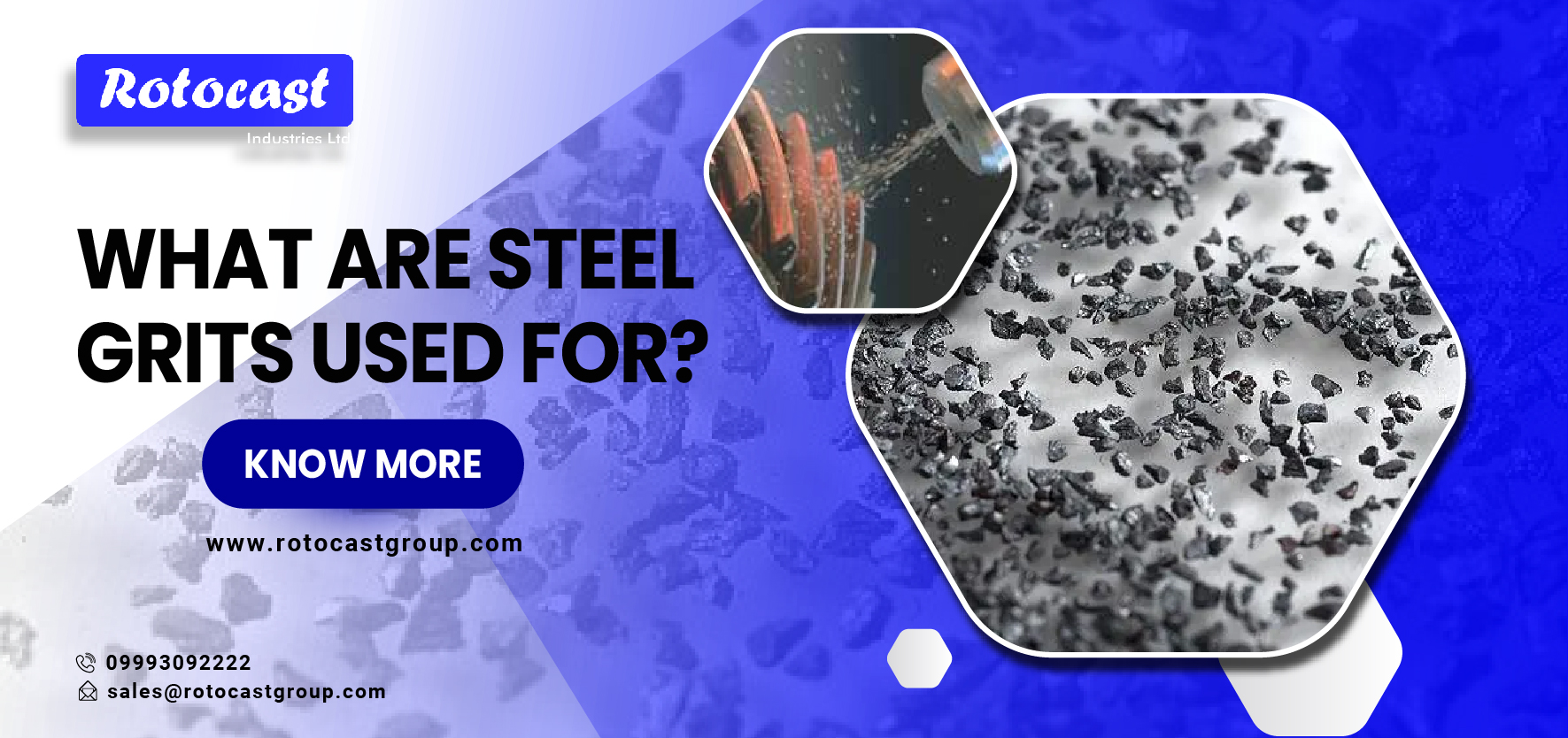
The right surface profile is the controlled pattern of peaks and valleys created on blast-cleaned steel that matches the coating system’s specified roughness range. Steel Grit Blasting creates this profile through angular cutting action. A useful profile is clean, repeatable, measurable, and appropriate for the primer or coating thickness that follows.
Surface Profile Is a Process Output, Not a Grit Number
Plants often try to solve roughness questions by asking for a single grit size. That is only one input. The profile actually seen on steel is produced by the combination of particle size, angularity, hardness, impact velocity, impingement angle, exposure time, working mix, and substrate condition. A change in wheel speed, nozzle pressure, abrasive flow, or separator efficiency can shift the result even when the purchase specification stays the same.
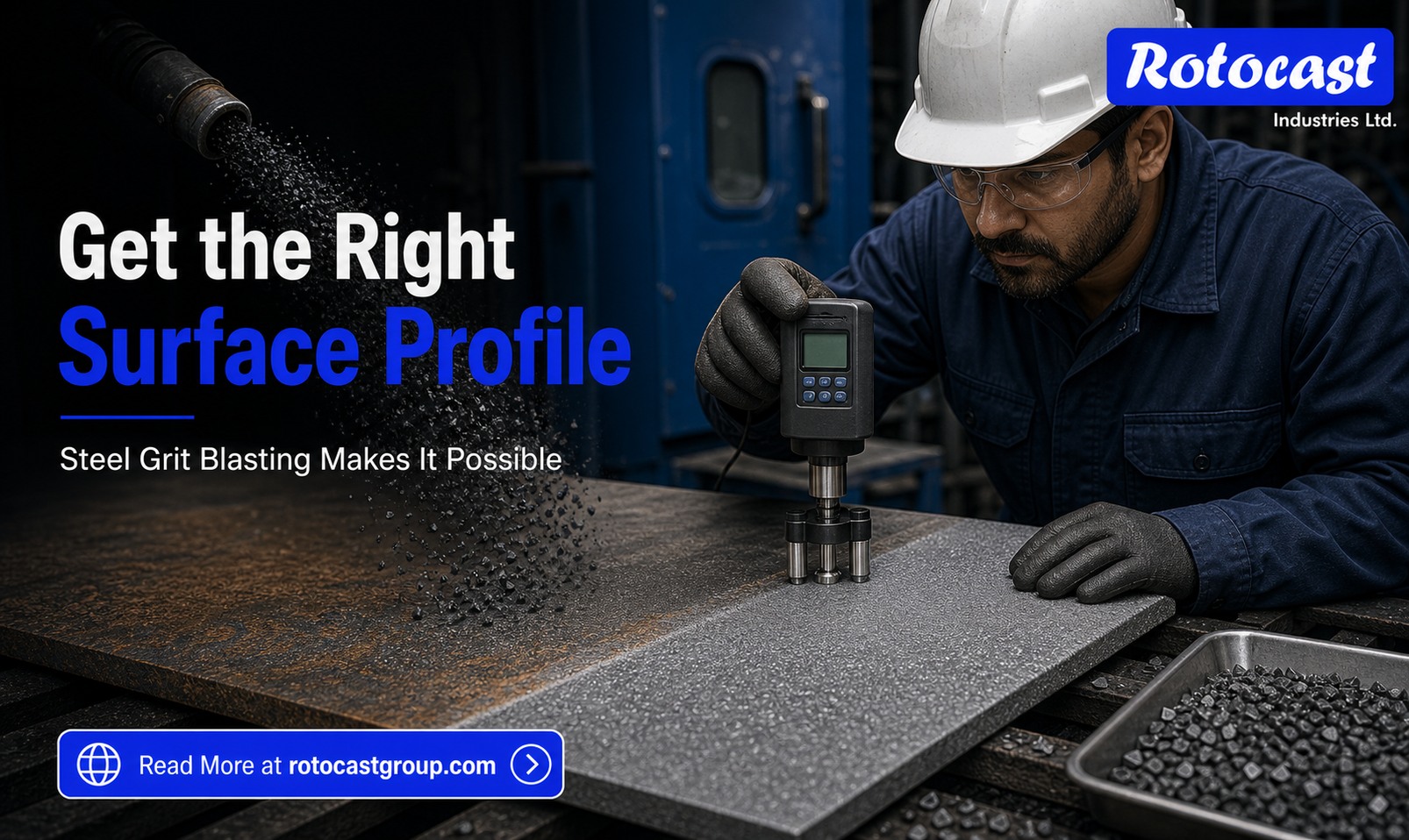
This is why surface profile must be verified on the part itself. ISO 8503 provides recognized approaches for assessing blast-cleaned steel roughness, including comparators and replica-tape methods. For production teams, measurement closes the loop between abrasive selection and coating performance.
What Each Blasting Variable Does
Particle size largely controls the scale of the texture: larger angular particles tend to cut deeper, while smaller particles create a finer pattern and can improve coverage. Hardness influences how long grit keeps sharp cutting edges. Velocity controls impact energy. Angle changes whether the particle cuts, slides, or impacts more directly. Time and coverage determine whether the entire surface receives enough effective impacts.
Working mix is the hidden variable. A healthy mix contains a controlled distribution of new, partially worn, and smaller particles. Too many fines reduce effective cutting; too many large particles can make the profile coarse and slow coverage. The separator is therefore part of the surface-profile system.
Decision Framework: Match the Profile to the Job
| Requirement | Media/process direction | Control check |
| Remove heavy scale | Higher cutting action with suitable grit size | Cleanliness + cycle time |
| Fine coating system | Finer, controlled profile | Profile measurement + primer coverage |
| Thick protective coating | Deeper but controlled profile | Peak coverage + coating DFT |
| Complex geometry | Balanced size mix and adequate coverage | Profile at flats, corners and recesses |
| High-volume production | Durable grit with stable working mix | kg/tonne, throughput, separator efficiency |
A Five-Step Method to Stabilize Surface Profile
- Start with the coating requirement. Confirm the cleanliness and roughness range required by the paint system or customer specification. Do not blast to an arbitrary “rough” finish.
- Establish a baseline. Record grit grade, hardness, machine settings, abrasive flow, blast time, and measured profile on a known-good batch.
- Control the working mix. Check sieve distribution, separator settings, fines removal, and abrasive replenishment. A drifting mix creates a drifting profile.
- Measure by location. Profiles can differ on flats, corners, welds, recessed geometry, and areas with different blast exposure. Sample representative zones.
- Trend, do not react. Use profile, consumption, throughput, dust load, and coating-inspection data together. One measurement shows a condition; a trend shows the process.
Common Profile-Control Mistakes
| Mistake | Profile risk | Corrective action |
| Increasing blast time without diagnosis | Overblasting or unnecessary wear | Check energy, media flow, cleanliness and profile first. |
| Running with too many fines | Shallow/slow cutting and dust | Improve separation and replenishment control. |
| Using one measurement point | Local variation goes undetected | Measure representative zones and geometry. |
| Changing grit and machine settings together | Cause of improvement/failure becomes unclear | Change one controlled variable at a time. |
Buying for Cost per Kilogram Can Distort the Process
An abrasive that looks economical at purchase can become expensive if it fractures rapidly, loses shape, creates excess dust, or forces longer blast cycles. A Steel Abrasives Manufacturer should be able to discuss hardness, durability, size distribution, and application fit—not only price.
Backed by 40+ years of excellence, 1000+ customers and 30,000 T annual capacity, Rotocast Industries Ltd. manufactures Steel Shot and Steel Grit with a focus on finish, consumption, equipment life and operational efficiency. For a plant manager, the useful KPI is cost per correctly prepared square metre or tonne—not simply cost per bag.
Plant-Floor Checklist Before You Change Grit Grade
When profile moves out of range, avoid changing abrasive grade immediately. First confirm blast pressure or wheel speed, abrasive flow, exposure time, separator cut, fines level, nozzle or wheel wear, and part presentation. A machine problem can imitate a media problem, and changing both at once makes root-cause analysis harder.
After any controlled change, compare at least three outputs: measured profile, cleaning/cycle time, and abrasive consumption. If the new setting deepens profile but sharply increases media use or equipment wear, the process may not be economically better. The objective is the narrowest stable window that repeatedly meets the coating requirement at acceptable cost.
Final Words
Consistent coating performance starts with a surface profile that is engineered, measured, and held inside a useful process window. Steel Grit Blasting delivers strong cutting action, but only when abrasive characteristics and machine conditions work together.
Explore products for steel abrasive options, or connect for customized abrasive solutions when your plant needs to stabilize profile, throughput, or abrasive consumption across production.
FAQs
- How does steel grit size affect surface profile?
Larger angular particles generally create a deeper, coarser profile; smaller grit creates a finer texture and can improve coverage. Actual profile also depends on velocity, hardness, angle, and working mix.
- How do I measure a blasted steel surface profile?
Use the method required by your specification. Common approaches include calibrated surface-profile comparators and replica tape with a suitable gauge.
- Can a surface profile be too rough for coating?
Yes. Excessive peaks can remain insufficiently covered by primer, increasing coating consumption and creating weak points. Match profile to the coating system.
- Why does profile change during the same production shift?
Typical causes include working-mix drift, separator changes, worn wheels/nozzles, media-flow variation, dust loading, and inconsistent exposure.
- Should I use Steel Shot or Steel Grit for profile creation?
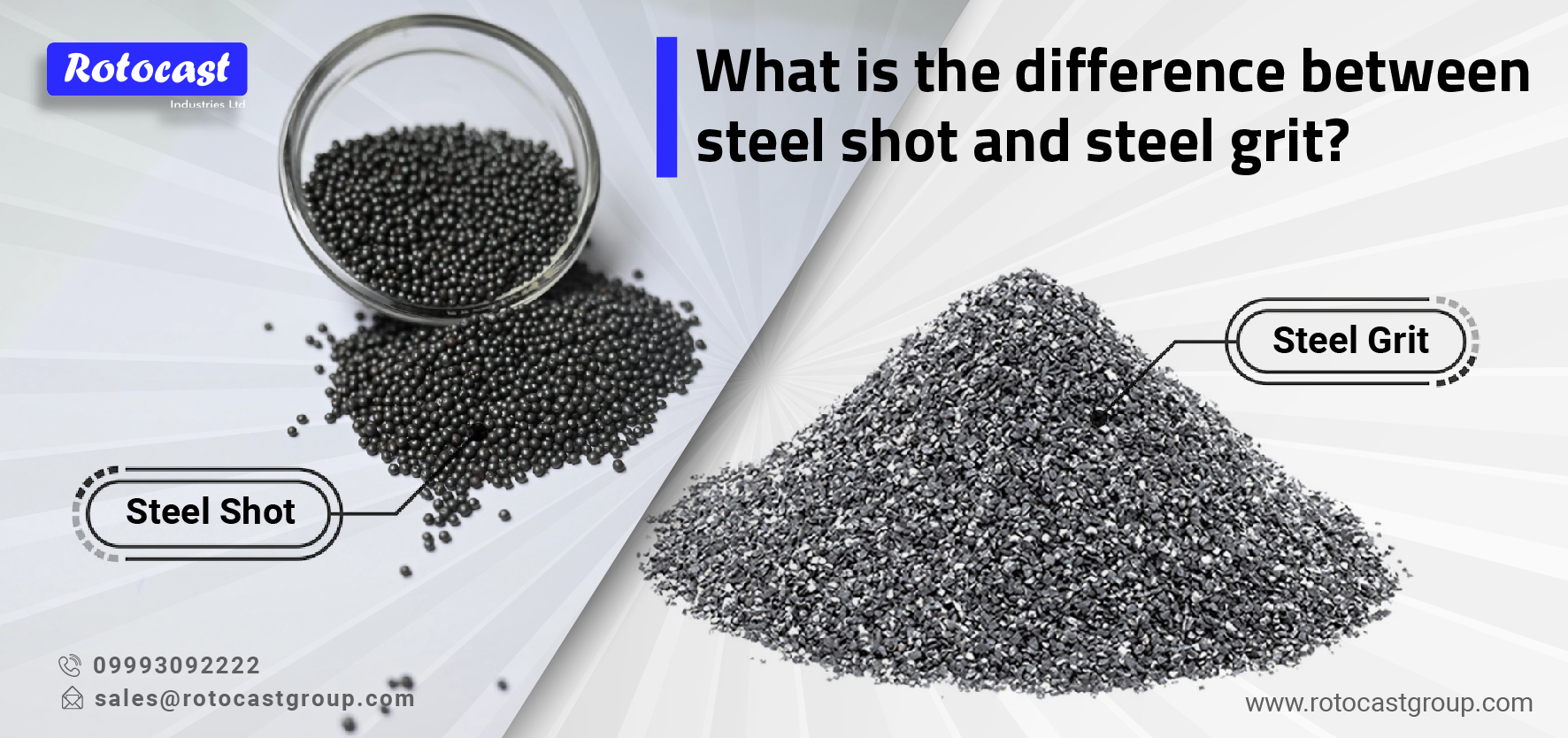
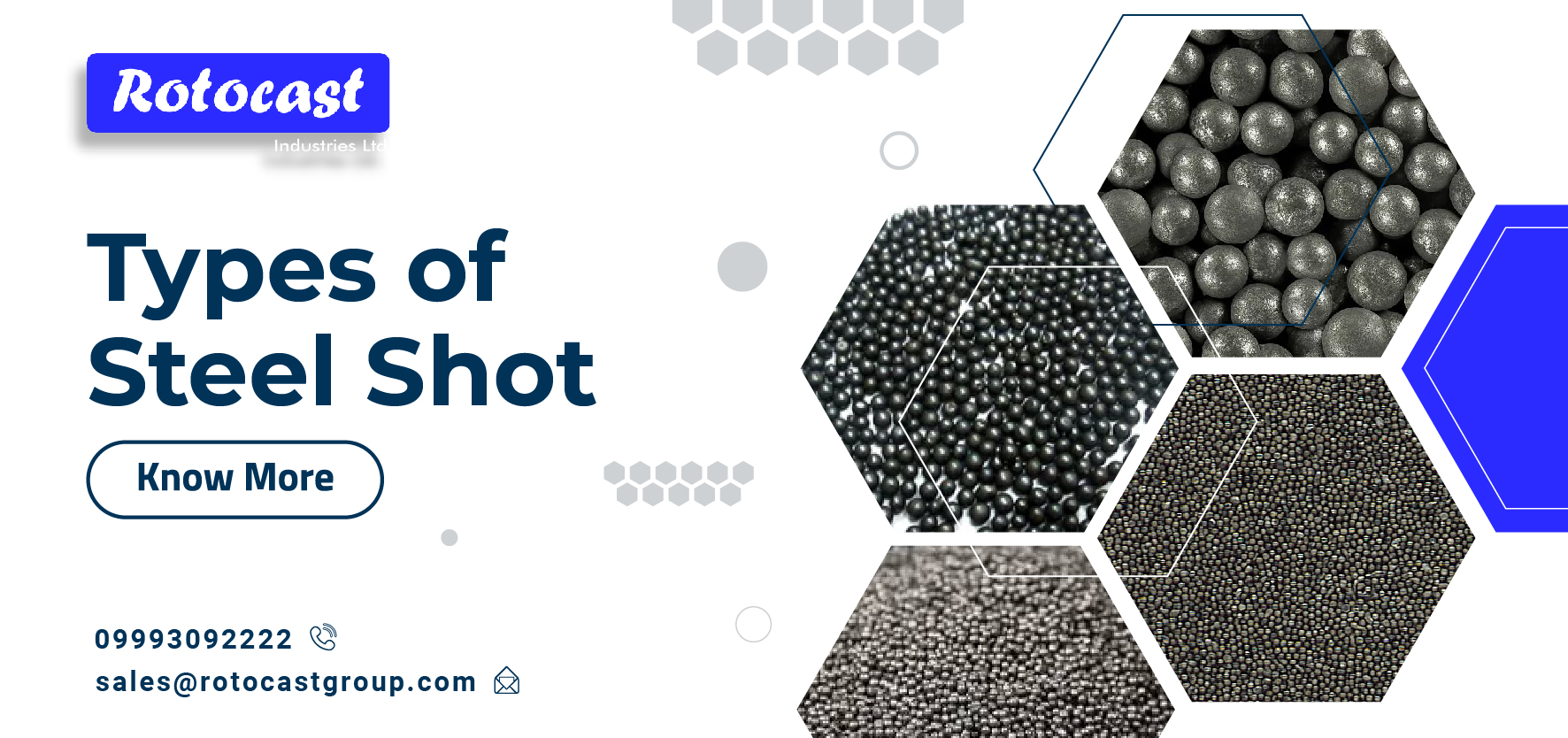
Steel Grit is angular and more effective for cutting and anchor-profile generation. Steel Shot is rounder and better suited where cleaning, peening, or a smoother finish is desired.