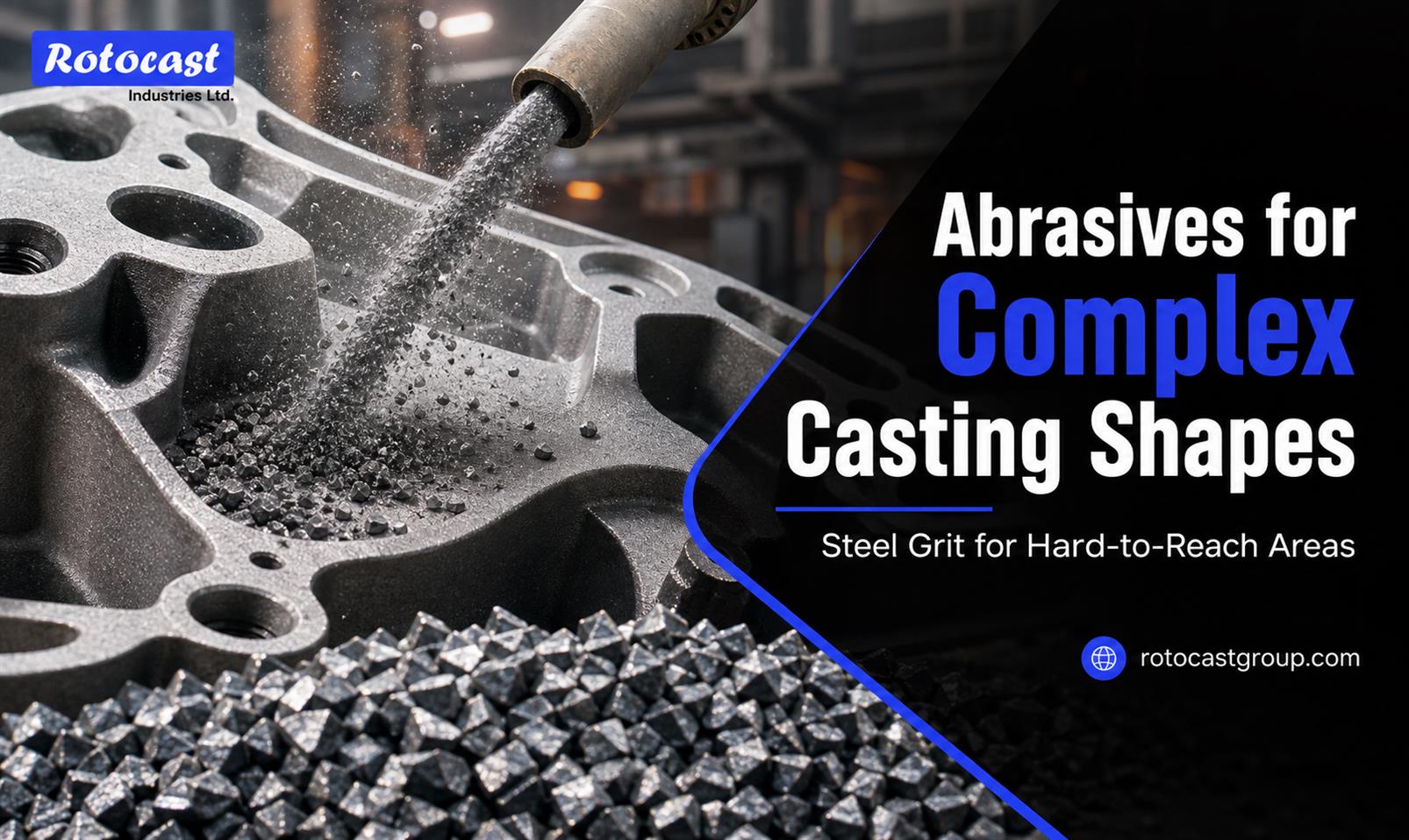
Not every casting presents a flat, easily accessible surface.
Modern foundries regularly produce components containing deep recesses, ribs, curved profiles, narrow openings, internal corners, pockets, undercuts, varying wall thicknesses, and other complex geometries.
For a Steel Casting Foundry, these shapes can make surface cleaning considerably more challenging.
Even when a blast machine is operating correctly, the wrong abrasive type, size, hardness, operating mix, or part orientation can leave areas partially cleaned while more exposed surfaces receive excessive blasting.
That is why abrasive selection should never be treated simply as choosing between Steel Shot and Steel Grit.
The goal is to match the abrasive and blasting process to the geometry, contamination level, desired surface condition, and downstream manufacturing requirement.
Why Complex Steel Castings Are More Difficult to Blast
During abrasive blasting, media must reach the surface with sufficient velocity and impact energy to remove sand, scale, oxidation, rust, or other contamination.
Simple external surfaces receive direct abrasive exposure relatively easily.
Complex castings create additional challenges because certain areas may be:
- Shielded from the primary blast stream
- Positioned at difficult impact angles
- Located behind ribs or projections
- Deep inside recessed sections
- Surrounded by narrow passages
- More sensitive to aggressive blasting
- Difficult to expose consistently during tumbling
This means that increasing blast time alone may not solve the problem.
Longer cycles can over-blast easily accessible surfaces while recessed areas remain insufficiently cleaned.
The better approach is to evaluate abrasive type, size, machine configuration, exposure pattern, and casting orientation together.
Understanding Steel Shot and Steel Grit
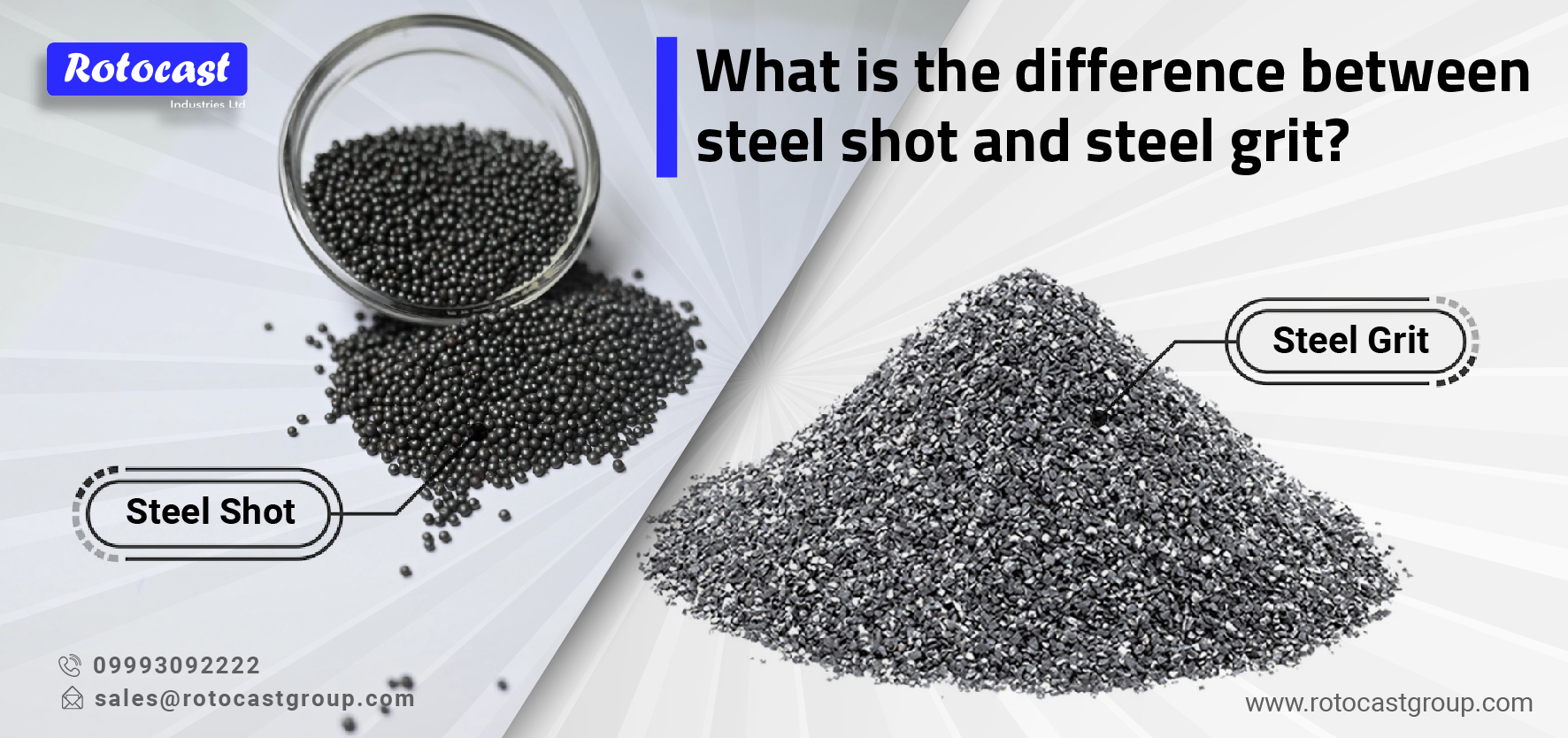
Steel abrasives are commonly available as spherical Steel Shot and angular Steel Grit. Their shapes produce different impact characteristics. For additional background on these abrasive forms, see Steel abrasive : Steel Abrasive
Steel Shot
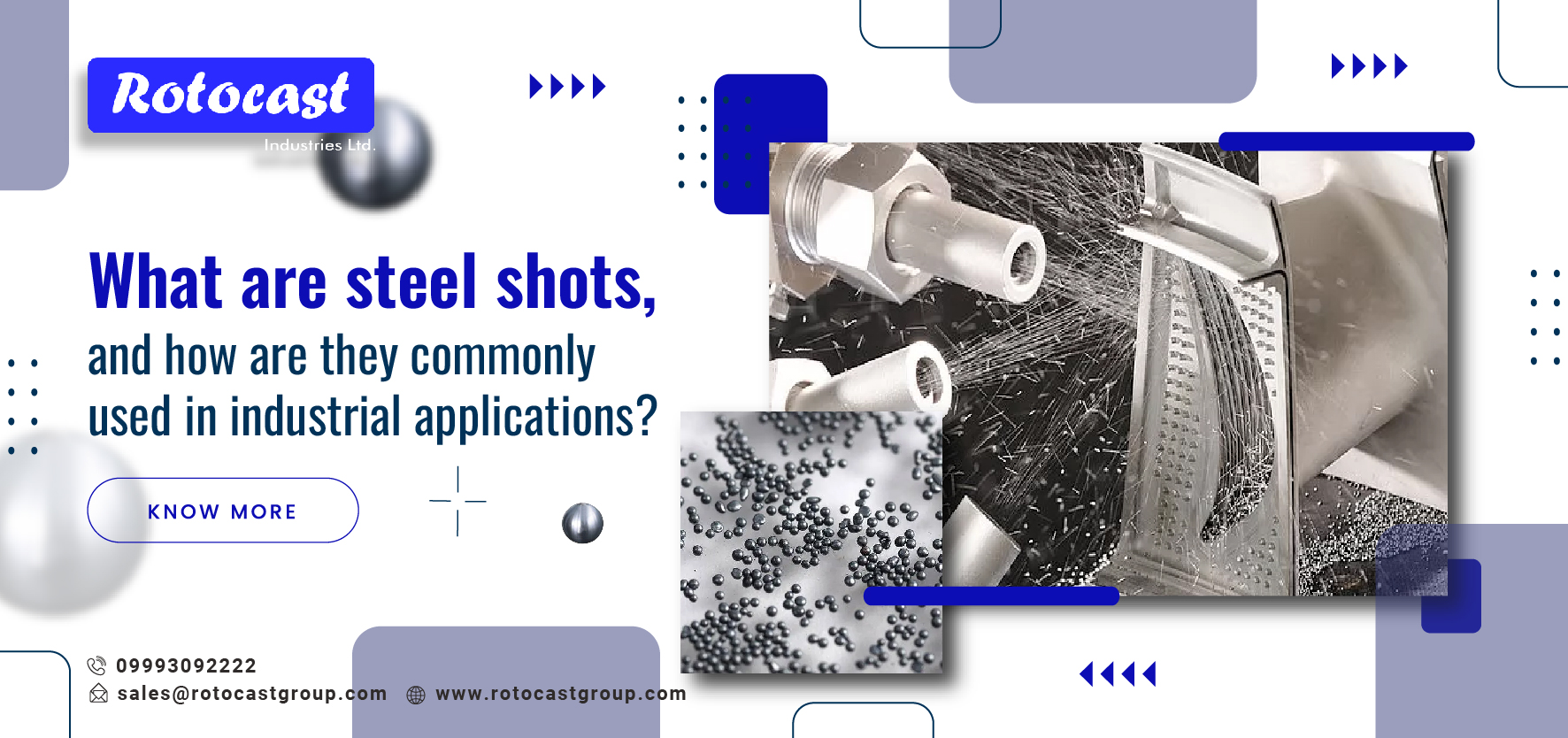
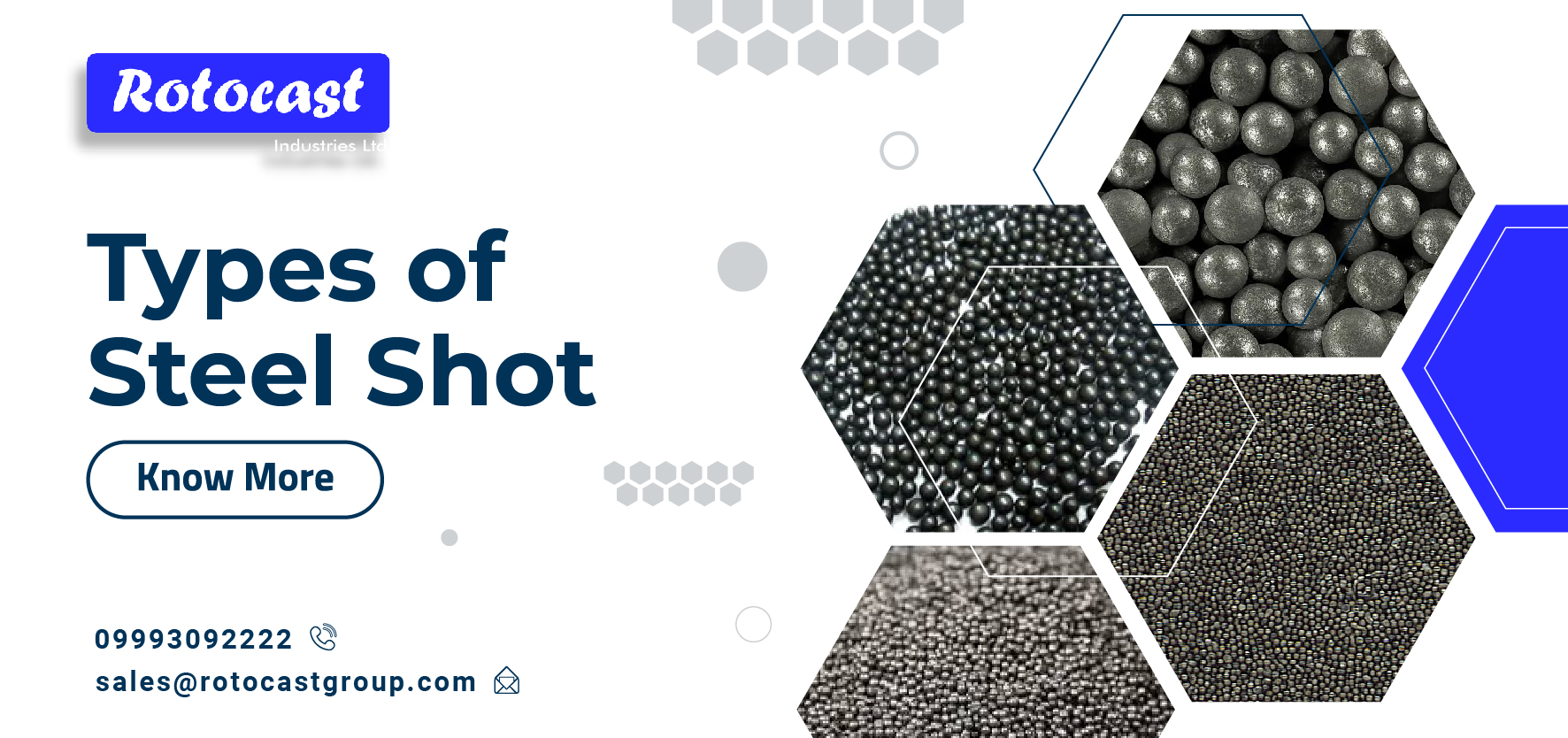
Steel Shot consists primarily of rounded or spherical particles.
Its impact action generally makes it suitable for applications requiring:
- Uniform cleaning
- Controlled impact
- Smoother surface appearance
- Casting cleaning
- Forging cleaning
- Shot peening
- General surface preparation
Foundries looking for consistent spherical blasting media can review Rotocast’s Steel Shot range – Steel Shot
Steel Grit
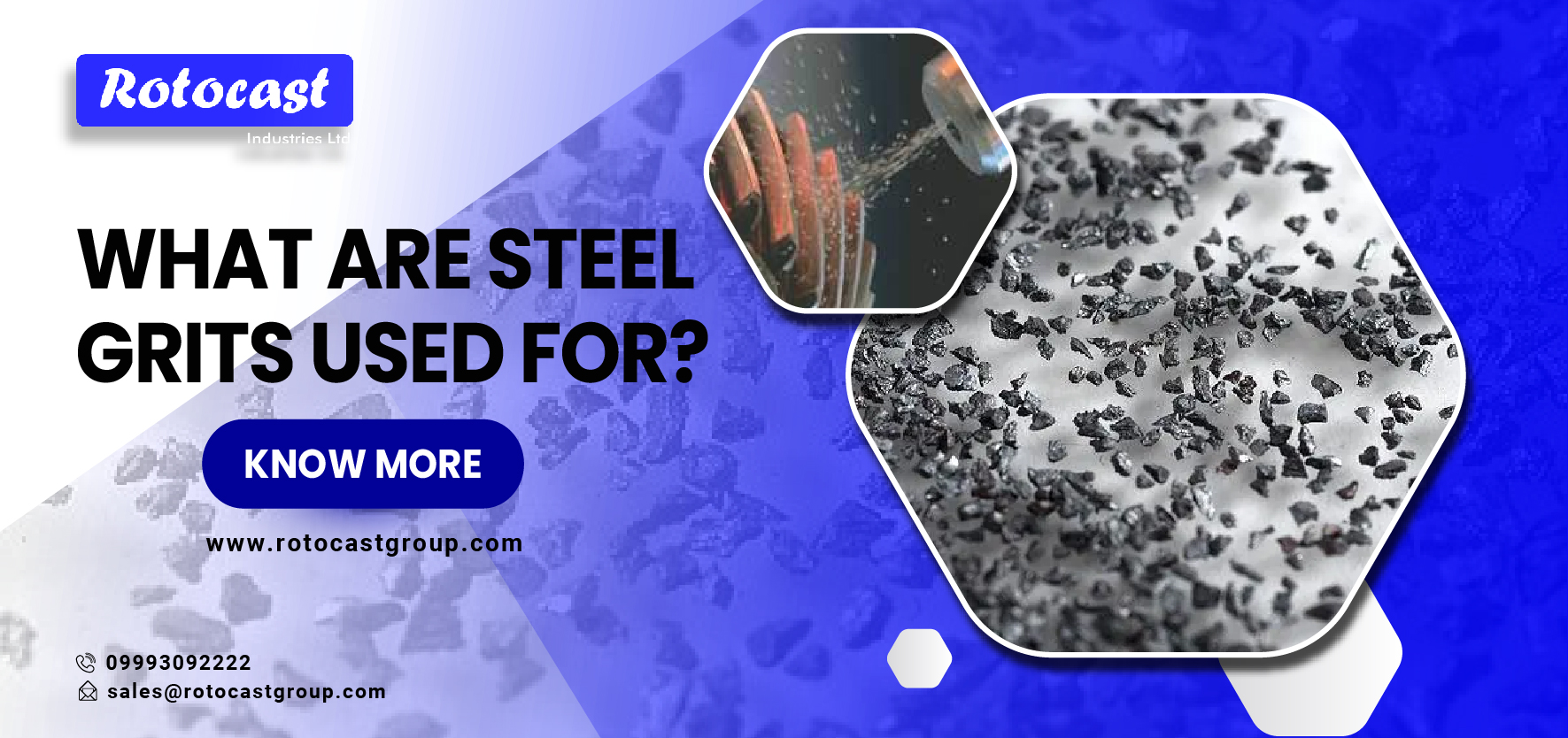
Steel Grit consists of angular particles that provide a stronger cutting action.
It is commonly considered where the requirement includes:
- Heavy scale removal
- Rust removal
- More aggressive cleaning
- Surface profiling
- Coating preparation
- Difficult contamination
Rotocast’s Steel Grit range includes grades designed for blasting and surface-preparation applications – Steel Grit
The correct choice depends on what the casting requires—not simply which abrasive appears more aggressive.
1. Begin With the Casting Geometry
Before selecting an abrasive, examine the casting itself.
Ask:
- Does the component contain deep recesses?
- Are there narrow channels?
- Are ribs blocking direct blast exposure?
- Are there internal corners?
- Does the component have thin sections?
- Are there surfaces hidden behind projections?
- Can the component rotate or tumble during blasting?
- Can the blast stream directly reach all critical surfaces?
These questions help determine whether the cleaning issue originates from the abrasive or from blast coverage.
Hard-to-Reach Does Not Always Mean “Use More Aggressive Grit”
One common mistake is assuming that Steel Grit will automatically solve every difficult cleaning problem.
If abrasive media physically cannot reach a surface at an effective angle, increasing hardness or aggressiveness may have limited benefit.
Part orientation, blast-wheel coverage, nozzle position, tumbling action, abrasive size, and exposure time may be equally important.
For a Steel Casting Foundry, geometry should therefore be considered before changing abrasive specifications.
2. Consider Abrasive Particle Size
Particle size can significantly influence both cleaning power and accessibility.
Larger abrasive particles
Larger Steel Shots or Steel Grits generally carry greater individual impact energy.
They may be beneficial for:
- Heavy contamination
- Thick scale
- Robust castings
- Large open surfaces
However, very large particles may have difficulty effectively reaching narrow recessed features.
Smaller abrasive particles
Smaller media can improve coverage density and may access tighter surface features more effectively.
They can be useful where castings contain:
- Fine details
- Smaller recesses
- Closely spaced ribs
- Narrow external profiles
- Intricate geometries
But smaller media also produces lower individual impact energy.
Therefore, selecting abrasive size is always a balance between accessibility, coverage, impact energy, and required cleaning intensity.
3. Match Abrasive Shape to the Cleaning Objective
Shape determines how abrasive energy interacts with the surface.
When Steel Shot may be preferred
Steel Shot is often appropriate when the objective is:
- General foundry cleaning
- Uniform surface appearance
- Removal of moulding residues
- Controlled surface treatment
- Reduced cutting action
- Shot peening
Because Steel Shots are predominantly spherical, they create a different impact pattern compared with angular grit.
When Steel Grit may be preferred
Steel Grit can be advantageous when:
- Scale is strongly adhered
- Rust is difficult to remove
- A stronger surface profile is needed
- Cutting action is required
- Coating preparation is the objective
A qualified Steel Grit Manufacturer should therefore offer different sizes and hardness grades rather than treating grit as one universal abrasive.
4. Abrasive Hardness Matters
Hardness affects how an abrasive behaves when it strikes the casting.
An abrasive that is excessively soft may deform too rapidly for aggressive cleaning.
An abrasive that is excessively hard for the process may fracture faster, increase fines, or create unnecessary surface aggression.
The ideal hardness therefore depends on:
- Casting material
- Contamination
- Machine type
- Required cleaning speed
- Desired surface finish
- Abrasive recycling system
- Required surface profile
Foundries should evaluate hardness together with size and shape rather than independently.
5. Do Not Ignore the Operating Mix
A blast machine rarely contains only freshly added abrasive.
During operation, media gradually changes through repeated impacts.
Particles wear down, some fracture, and new abrasive is added to maintain the process.
This produces an operating mix containing multiple particle sizes.
A controlled operating mix can help maintain a balance between:
- Impact energy
- Surface coverage
- Cleaning speed
- Access to finer geometries
- Surface uniformity
An uncontrolled mix containing excessive fines may reduce useful cleaning energy.
On the other hand, an operating mix dominated only by oversized fresh particles may reduce coverage in finer areas.
Maintaining the correct abrasive balance is therefore especially important for complex castings.
6. Evaluate Part Orientation and Rebound
For irregular castings, abrasive selection alone cannot guarantee uniform cleaning.
The component must also be positioned so that critical areas receive sufficient exposure.
In tumblast applications, movement of the components continually changes the angle at which abrasive media contacts the casting.
In other blasting systems, fixtures, hangers, rotating tables, or manipulators may be required to expose different surfaces.
Rebound can also contribute to cleaning surfaces that do not receive direct blast impact.
However, rebound should be considered a supporting mechanism rather than a substitute for correct machine coverage.
If a recessed zone repeatedly leaves the machine dirty, investigate:
- Abrasive size
- Abrasive condition
- Blast pattern
- Wheel or nozzle alignment
- Casting orientation
- Cycle duration
- Machine loading
- Separator performance
7. Match the Abrasive to Surface Condition
Different contaminants require different levels of cleaning action.
Loose moulding sand
General Steel Shot blasting may provide sufficient cleaning depending on the casting and machine.
Heavy burnt-on sand
Greater impact or more aggressive media characteristics may be required.
Oxidation and light scale
A properly selected operating mix may provide effective cleaning.
Heavy scale
Steel Grit or a suitably aggressive process may be more appropriate.
Rust and coating removal
Angular Steel Grit is frequently considered where stronger cutting action and surface profiling are required.
Foundries experiencing rough or inconsistent results can also review Rotocast’s technical discussion on abrasive selection and rough castings – Steel Casting Foundry Abrasive Guide
Steel Shot vs Steel Grit for Complex Castings
| Requirement | Steel Shot | Steel Grit |
|---|---|---|
| General casting cleaning | Excellent option | Application dependent |
| Smooth, uniform finish | Strong | More aggressive |
| Heavy scale removal | Moderate to strong depending on grade | Strong |
| Surface profiling | Lower cutting action | Strong |
| Rust removal | Suitable in some processes | Often preferred |
| Shot peening | Preferred | Generally not primary choice |
| Delicate surfaces | Better when correctly sized | Requires careful control |
| Aggressive cutting | Limited | High |
| Recessed geometry | Depends strongly on media size and machine coverage | Depends strongly on media size and machine coverage |
The important point is that geometry cannot be solved by abrasive shape alone.
8. Consider SAE Abrasive Size Specifications
Industrial Steel Shots and Steel Grits are available in standardized size classifications.
SAE J444 establishes size designations used for cast shot and grit used in cleaning and peening applications. More information is available in the SAE J444 reference : SAE J444
Standardized sizing helps plants communicate abrasive requirements more consistently and maintain repeatability when replenishing blast media.
However, specifying a recognized size is only the starting point.
Plants must still validate how that grade performs in their actual:
- Blast machine
- Casting geometry
- Operating mix
- Production cycle
- Surface specification
9. Watch for Over-Blasting
Hard-to-reach areas sometimes tempt operators to increase cycle time.
This can create another problem: easily accessible surfaces continue receiving abrasive impact while difficult areas gradually clean.
The result may include:
- Unnecessary surface roughness
- Increased media consumption
- Longer cycle time
- Greater equipment wear
- Lower overall throughput
If one region repeatedly requires substantially more blasting time, investigate coverage rather than simply extending every cycle.
10. Use a Hybrid Cleaning Strategy When Necessary
Some casting geometries cannot be fully cleaned by a single blasting stage.
Internal cavities, blind holes, extremely narrow passages, or shielded sections may require supplementary treatment.
In such cases, an efficient process may combine:
Primary shot blasting + targeted secondary cleaning
This is usually more productive than manually cleaning the entire component.
Mechanical blasting handles the surfaces it can reach efficiently, while operators focus only on genuinely inaccessible areas.
11. Consider the Total Cost per Clean Casting
Procurement teams often compare abrasives according to price per kilogram.
That alone does not reveal actual process cost.
A better measure is:
Total abrasive and operating cost per acceptable cleaned casting
Consider:
- Abrasive consumption
- Cleaning cycle time
- Reblasting rate
- Manual touch-up
- Dust generation
- Machine wear
- Media breakdown
- Surface-quality rejection
- Production downtime
An abrasive that costs slightly more per kilogram may deliver better economics if it reduces rework and improves cleaning consistency.
Choosing a Shot Manufacturer in India
A foundry searching for a Shot Manufacturer in India or Steel Grit Manufacturer in India should evaluate technical capability along with price.
Important questions include:
- Are multiple Steel Shot sizes available?
- Are multiple Steel Grit sizes and hardness ranges available?
- Is abrasive quality consistent from batch to batch?
- Can the manufacturer support foundry applications?
- Are products manufactured to recognized specifications?
- Is technical guidance available?
- Can abrasive performance be optimized for a specific blasting machine?
- Is supply reliable for continuous production?
A reliable Steel Shot Manufacturer, Steel Grit Manufacturer, or Steel Abrasives Manufacturer should understand that abrasive selection changes according to geometry, machine type, finish requirement, and production target.
Rotocast’s broader abrasive and surface-preparation portfolio can be reviewed here – Steel Abrasives Manufacturer Product Range
Steel Shot India and Steel Grit India: Select by Performance, Not Keyword Alone
Buyers searching for Steel Shot India, Steel Shots India, Steel Grit India, or Steel Grits India will find numerous options.
The final selection should not depend solely on price or supplier location.
Abrasive quality influences:
- Surface consistency
- Cleaning efficiency
- Consumption
- Dust generation
- Rework
- Machine operating stability
The best media is the one that produces the required surface condition efficiently and repeatedly within the actual foundry process.
A Practical Selection Checklist
Before finalizing an abrasive for a complex casting, ask:
Casting
- What material is being blasted?
- How complex is its geometry?
- Which areas are hardest to reach?
- Are thin or delicate sections present?
Contamination
- Sand?
- Rust?
- Scale?
- Oxidation?
- Previous coating?
Required result
- Cleaning only?
- Smooth finish?
- Surface roughness?
- Coating preparation?
- Peening?
Abrasive
- Steel Shot or Steel Grit?
- What size?
- What hardness?
- What operating mix?
Equipment
- Wheel blast or air blast?
- Is the blast pattern correct?
- Are nozzles or wheels worn?
- Is the separator functioning correctly?
- Can the component rotate or tumble sufficiently?
Making these decisions together produces far better results than changing abrasive media through trial and error.
Final Takeaway
Complex castings require more than powerful blasting.
They require controlled abrasive selection and controlled abrasive delivery.
Steel Shot can provide effective, uniform impact for many foundry-cleaning applications, while Steel Grit provides stronger cutting action when scale, rust, or surface profiling demand a more aggressive approach.
But for deep recesses, ribs, pockets, and other hard-to-reach areas, media shape is only one part of the solution.
Particle size, hardness, operating mix, blast pattern, casting orientation, equipment condition, and cycle control must all work together.
For a Steel Casting Foundry, the ideal abrasive is therefore not simply the hardest or largest option.
It is the abrasive that reaches the required surfaces, removes contamination efficiently, creates the specified finish, minimizes rework, and delivers repeatable results at production scale.
FAQs
1. Which is better for complex steel castings: Steel Shot or Steel Grit?
It depends on the surface condition and desired finish. Steel Shot is generally suitable for uniform cleaning and controlled impact, while Steel Grit provides stronger cutting action for scale, rust, and surface profiling.
2. Can smaller Steel Shots reach recessed areas better?
Smaller media can provide higher coverage density and may access tighter external features more effectively, but actual cleaning also depends on blast angle, machine configuration, component orientation, and impact energy.
3. Why do some areas remain dirty after shot blasting?
Common reasons include poor blast coverage, incorrect component orientation, unsuitable abrasive size, worn blast wheels or nozzles, excessive fines, incorrect operating mix, or surfaces shielded from the primary blast stream.
4. What should a Steel Casting Foundry consider before changing abrasives?
Review the casting geometry, contamination, required surface finish, abrasive size, hardness, machine configuration, blast pattern, operating mix, and separator performance before changing media.
5. Why is choosing a reliable Steel Abrasives Manufacturer important?
Consistent abrasive size, hardness, shape, cleanliness, and durability help maintain predictable blasting performance. Reliable technical support can also help reduce rework and optimize abrasive consumption.