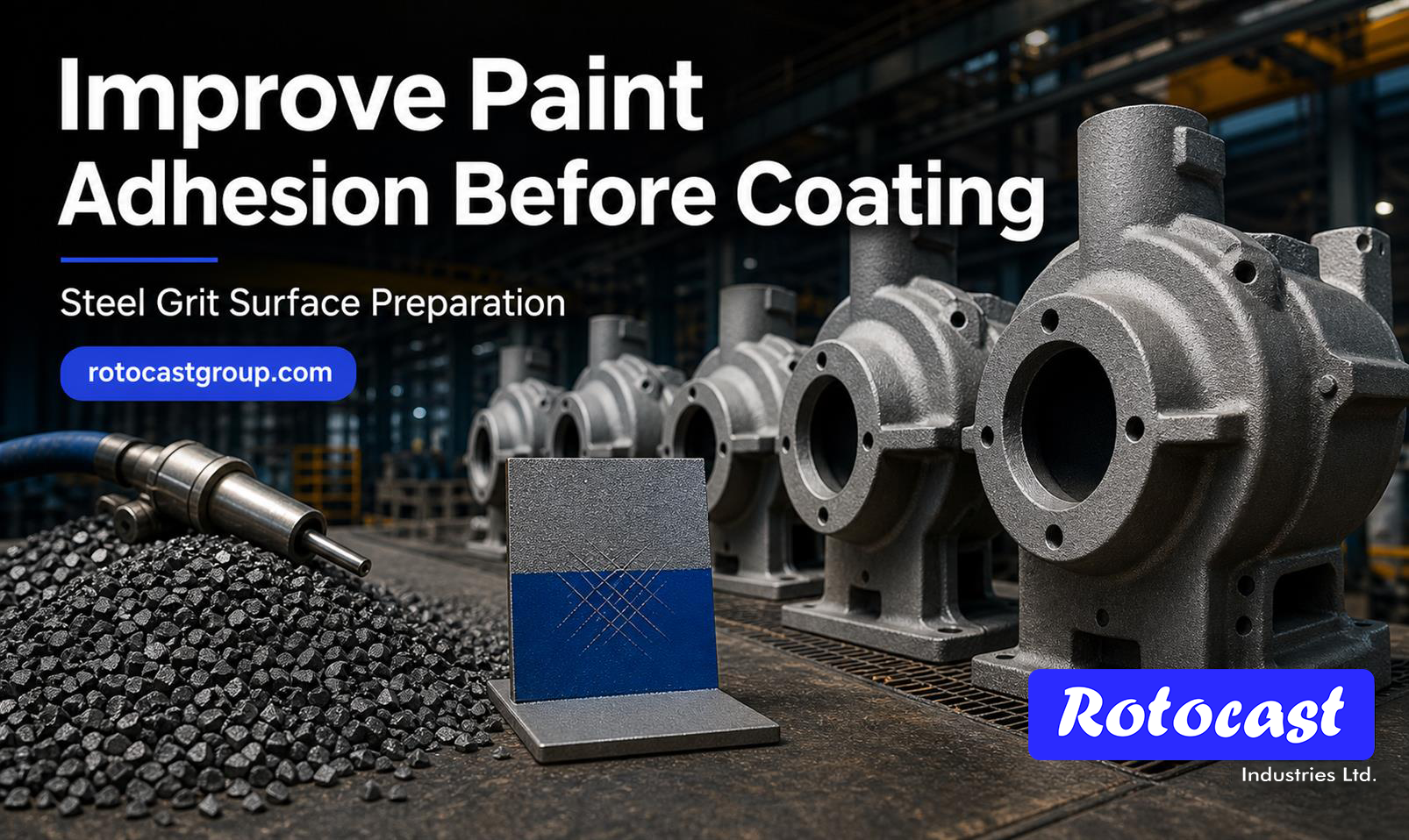
A freshly painted steel casting can look perfect when it leaves the coating line.
But if the paint begins to blister, peel, flake or lift prematurely, the real problem may have started before the first drop of coating was applied.
For a Steel Casting Foundry, paint performance depends heavily on surface preparation. Residual scale, sand, rust, oil, blasting dust or an unsuitable surface profile can prevent the coating from developing a reliable bond with the underlying steel.
This makes surface preparation much more than a cosmetic cleaning operation.
It is part of the coating system itself.
The objective is not simply to make a casting “look clean.” It is to create a surface that is sufficiently clean, uniform and properly profiled for the coating that follows.
So, how can foundries improve paint adhesion before final coating?
Here are seven areas that deserve close attention.
1. Remove More Than What the Eye Can See
The first mistake is assuming that a visually clean casting is necessarily coating-ready.
A newly manufactured Steel Casting Steel Casting can carry several types of surface contamination, including:
- 🔹 Moulding sand and burnt-on residue
- 🔹 Mill scale and oxide layers
- 🔹 Rust
- 🔹 Dust
- 🔹 Oil and grease
- 🔹 Previous coating residue
- 🔹 Handling contamination
Even small contaminated areas can interfere with coating wetting and bonding.
This is why cleaning should be evaluated as a controlled manufacturing process rather than simply by visual appearance.
The coating can only bond effectively to the surface it actually touches.
If contamination remains between the steel and coating, the bond is already compromised.
2. Select the Abrasive According to the Required Surface Profile
Abrasive selection has a major influence on how the prepared casting surface behaves.
Different coatings need different surface conditions. Producing an unnecessarily smooth surface can limit mechanical anchoring, while creating an excessively aggressive profile can also cause coating-related problems.
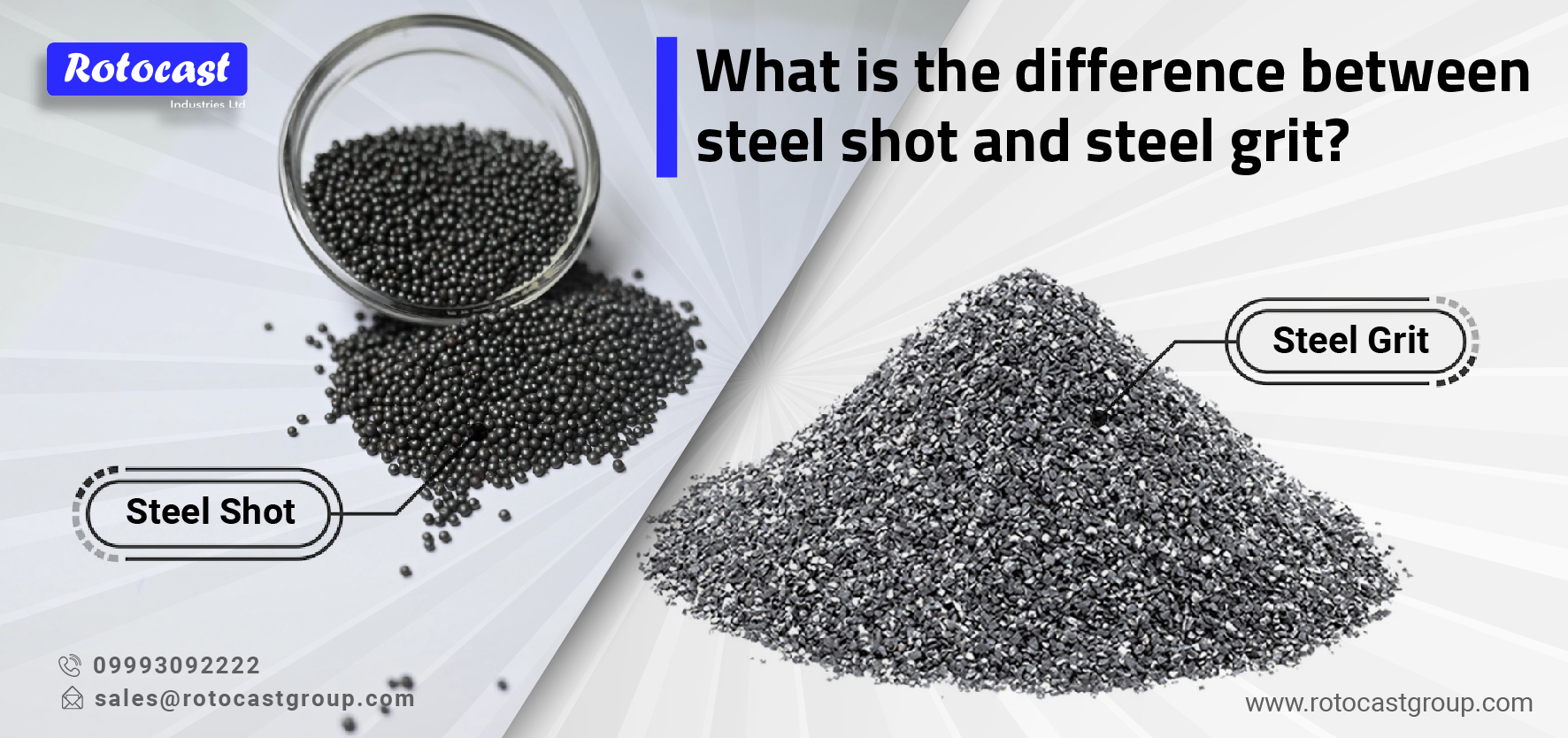
This is where understanding the difference between Steel Shot and Steel Grit becomes important.
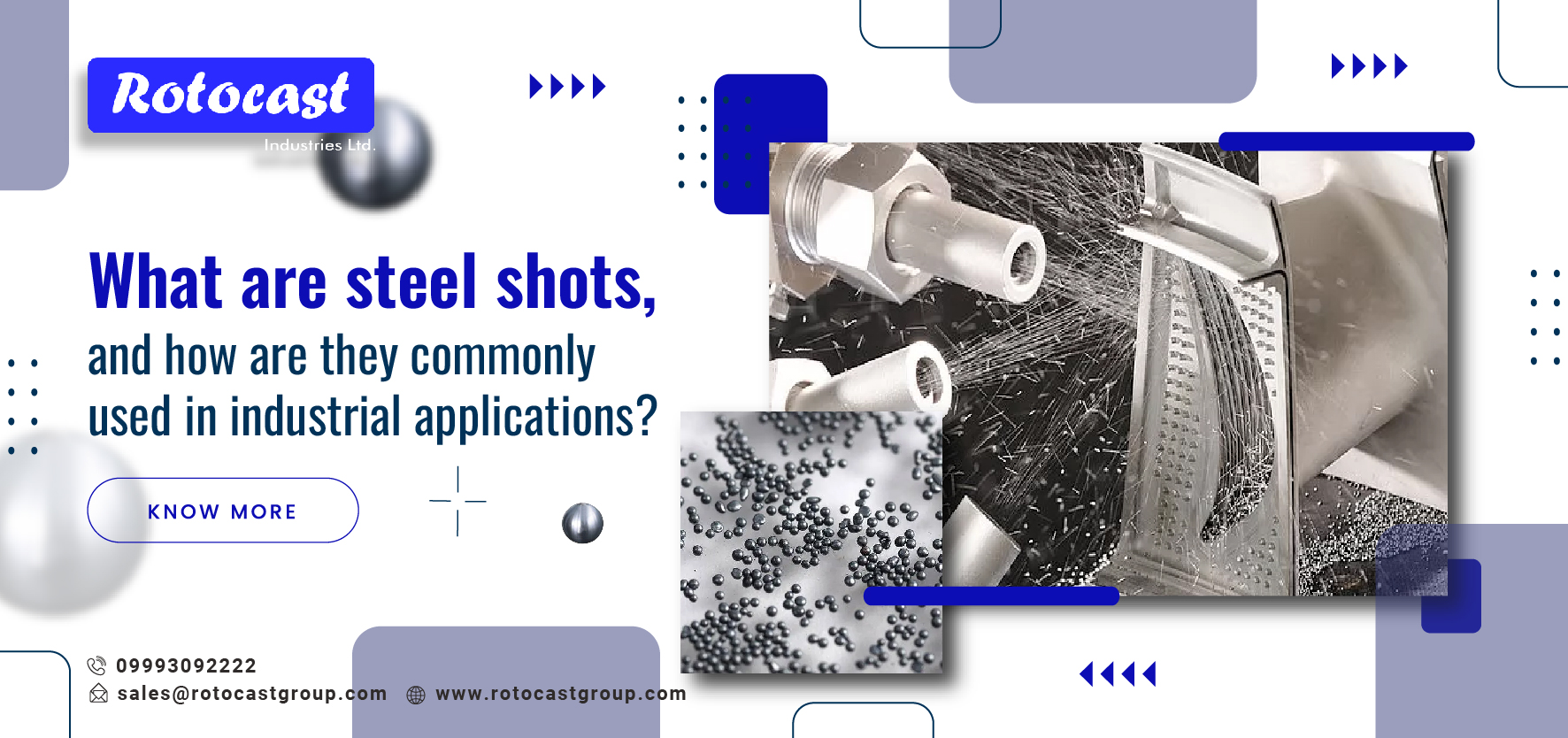
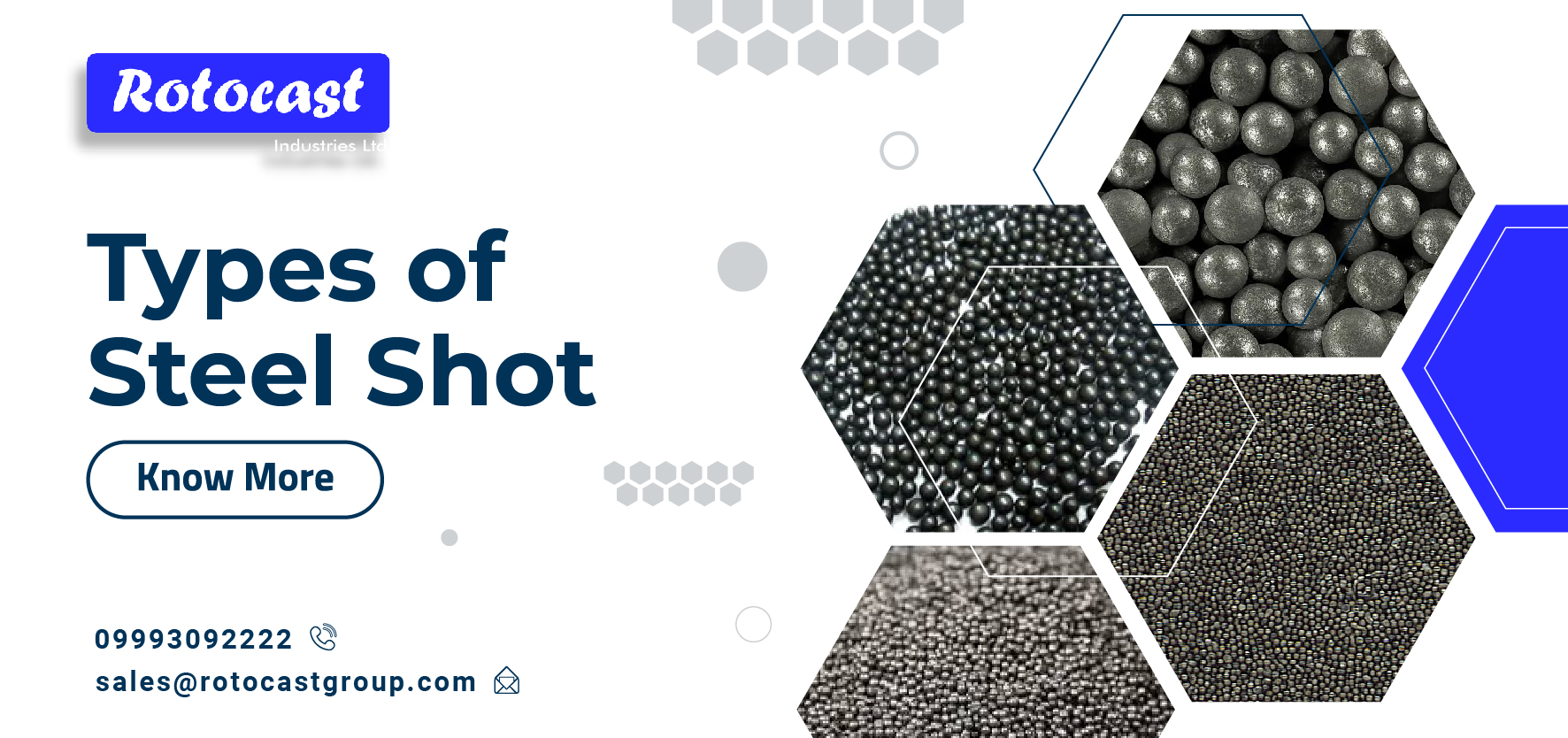
Spherical Steel Shot generally delivers a comparatively smoother and more controlled surface condition while efficiently removing scale and contamination.
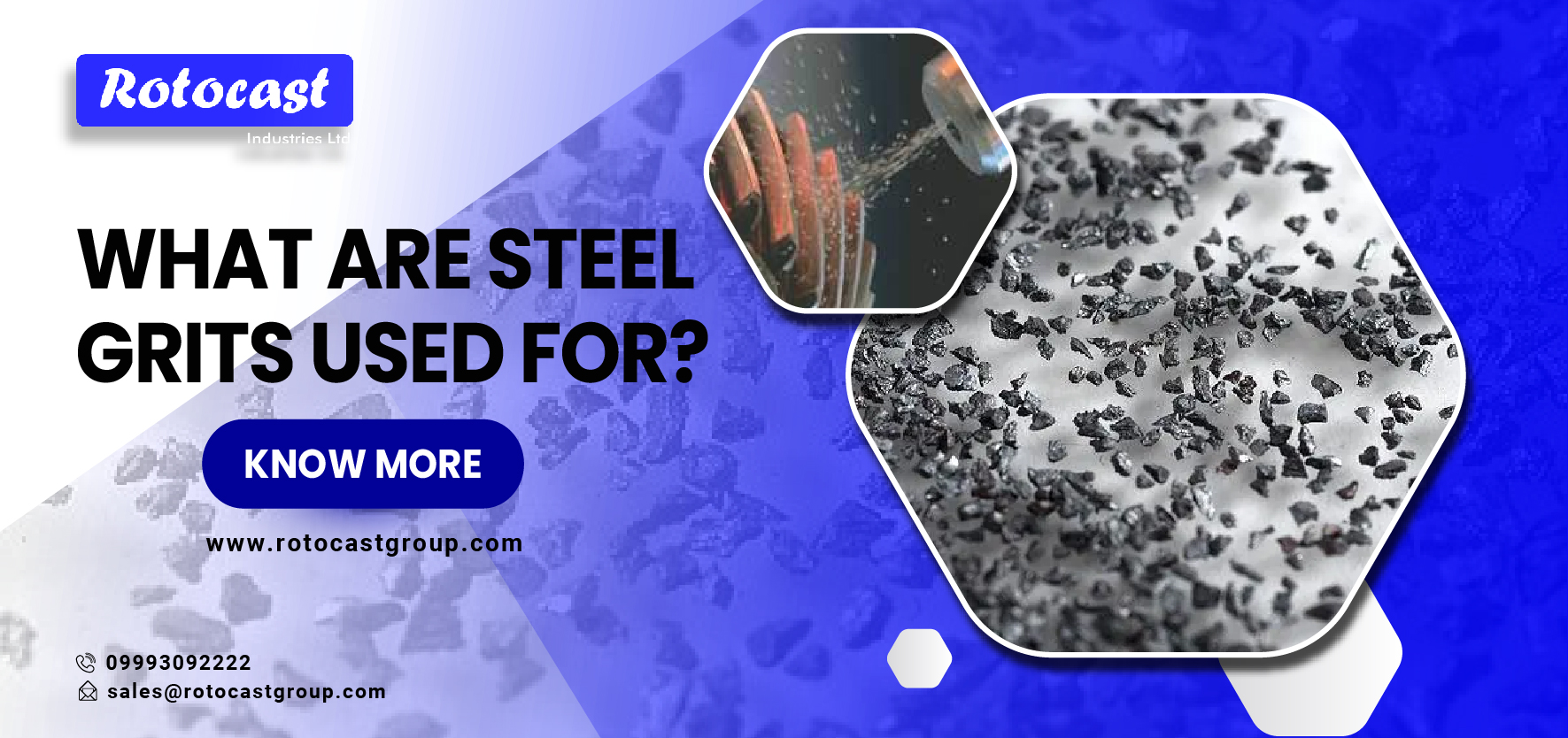
Angular Steel Grit provides stronger cutting action and is commonly used when more aggressive cleaning or a more pronounced surface profile is required. Rotocast notes that its steel grit is used in coating and rust removal applications where cleaning speed is important.
The correct choice therefore depends on:
- The casting material.
- Existing contamination.
- Required cleanliness.
- Required surface roughness.
- Coating thickness.
- Coating manufacturer’s recommendation.
- Blast equipment configuration.
The goal should not be the roughest possible surface.
It should be the right surface for the selected coating system.
3. Build the Correct Anchor Profile Before Painting
Paint does not simply sit on a steel surface.
A properly prepared surface provides microscopic peaks and valleys that allow many industrial coatings to develop mechanical anchorage.
Steel abrasives are widely used for precisely this reason: apart from removing scale, rust and contaminants, they can physically modify a metal surface and create roughness that supports coating application.
But profile consistency matters just as much as profile depth.
Consider two castings from the same production batch:
- Casting A receives uniform blasting across the complete surface.
- Casting B has aggressively blasted exposed areas but inadequately cleaned recesses.
Both may appear acceptable from a distance.
Yet their coating performance may be very different.
This is particularly important for castings containing:
- Deep pockets
- Curved sections
- Ribs
- Internal corners
- Recessed areas
- Narrow openings
- Irregular geometries
Rotocast’s existing Steel Casting Foundry guidance highlights how complex geometry can make abrasive coverage considerably more difficult.
Paint adhesion therefore begins with uniform blast coverage, not merely average surface cleanliness.
4. Control the Operating Mix—Not Just the Abrasive You Purchase
One of the most overlooked variables in shot blasting is the abrasive actually circulating inside the machine.
The material initially purchased is not necessarily identical to the operating mix after many blasting cycles.
During operation:
- Larger particles gradually wear.
- Some particles fracture.
- Smaller particles accumulate.
- Fines are removed by the separator.
- New abrasive is added.
- The particle-size distribution continuously changes.
If this operating mix becomes unstable, the blast process can become inconsistent.
That may create variations in:
- Cleaning speed
- Impact energy
- Surface profile
- Coverage
- Cycle time
- Finished surface condition
Inconsistent blasting media can also contribute to incomplete cleaning or uneven surface profiles, conditions that may increase the risk of coating defects and rework.
This means that buying high-quality abrasives is only step one.
Foundries must also manage what happens to those abrasives inside the machine.
5. Remove Blasting Dust Before the Coating Stage
Blasting removes contamination from the steel surface—but the removed material has to go somewhere.
Fine abrasive particles, broken scale and dust can remain on the casting after blasting.
If coating is applied over that loose material, the paint may bond partly to the contamination rather than directly to the prepared steel.
That creates a weak interface.
Before coating, foundries should therefore verify that the prepared surface is:
- ✅ Free from loose dust
- ✅ Free from abrasive residue
- ✅ Free from scale
- ✅ Free from grease
- ✅ Dry
- ✅ Protected against unnecessary contamination
This becomes even more important when blasted components travel between separate blasting, inspection and coating areas.
A perfectly blasted surface can still be compromised by poor handling after blasting.
6. Reduce the Delay Between Blasting and Final Coating
A cleaned steel surface does not remain in the same condition forever.
Once scale, rust and contamination are removed, fresh steel is exposed to the surrounding environment.
Humidity, moisture, handling and airborne contamination can begin affecting the surface before coating.
Therefore, the production workflow should be organised so that unnecessary delays between blasting and coating are minimised.
A practical flow is:
Blasting → Inspection → Dust Removal → Surface Verification → Coating
—not:
Blasting → Storage → Handling → Waiting → Re-handling → Coating
Foundries should also avoid touching cleaned coating surfaces unnecessarily with bare hands, oily gloves or contaminated lifting equipment.
Good blasting followed by poor post-blast handling can undo much of the benefit of surface preparation.
7. Stop Treating Abrasive Price as the Only Blasting Cost
When evaluating blasting media, some procurement teams naturally focus on cost per kilogram.
But paint adhesion problems demonstrate why abrasive economics should be considered more broadly.
The true cost of surface preparation can include:
- ❌ Abrasive consumption
- ❌ Blast-cycle time
- ❌ Electricity
- ❌ Machine wear
- ❌ Manual touch-up
- ❌ Reblasting
- ❌ Paint rejection
- ❌ Coating rework
- ❌ Component delays
- ❌ Customer complaints
A cheaper abrasive that produces unstable cleaning or an inconsistent profile may ultimately create a more expensive finished casting.
A capable Steel Abrasives Manufacturer should therefore be evaluated on consistency, technical performance, application understanding and the ability to supply the right abrasive characteristics—not simply the purchase price.
Rotocast describes steel shot and steel grit among its long-established steel abrasive product portfolio serving foundry, forging, automotive and engineering applications.
Steel Shot vs Steel Grit for Paint Preparation
Both media can play valuable roles, but they behave differently.
Steel Shot
Round Steel Shots tend to provide impact-based cleaning and a smoother surface condition.
They can be useful where foundries need:
- Consistent cleaning
- Scale removal
- Controlled surface finishing
- Less aggressive profiling
- Reusable metallic abrasive performance
Steel Grit
Angular Steel Grits provide more cutting action.
They are especially relevant where the process requires:
- Aggressive rust removal
- Previous coating removal
- Stronger surface profiling
- Rapid cleaning
- Coating-oriented surface preparation
Steel Grits and Steel Shots are both established types of steel abrasive, with shot having spherical grains and grit having a predominantly angular form.
In many industrial processes, the answer is not simply “shot or grit.”
The correct abrasive type, size, hardness and operating mix should be selected according to the required surface condition and coating specification.
5 Common Reasons Paint Still Fails After Shot Blasting
Even when a foundry already uses shot blasting, coating failures can continue if important process variables are overlooked.
1. Incomplete blasting in recessed areas
Complex casting geometries may prevent abrasive from reaching every surface with sufficient energy.
2. Incorrect abrasive size
Particles that are too large or too small for the equipment and application can affect cleaning efficiency and profile development.
3. Uncontrolled abrasive hardness
Hardness influences how abrasives behave, wear and fracture during blasting.
4. Poor separator performance
An operating mix containing excessive fines, dust or contaminants may reduce blasting consistency.
5. Contamination after blasting
Even a correctly prepared casting can become contaminated again during storage, handling or transportation to the coating line.
These problems demonstrate why surface preparation must be managed as a complete process rather than a single machine operation.
How a Steel Casting Foundry Can Improve the Process
A practical improvement programme does not need to begin with expensive equipment replacement.
Start by auditing the existing process.
Step 1: Define the coating requirement
Understand the cleanliness and surface-profile requirements recommended for the paint or coating system.
Step 2: Inspect incoming casting condition
Determine what the blast process actually needs to remove.
Step 3: Review abrasive selection
Check whether the Steel Shot India or Steel Grit India grade being used produces the required cleaning action and profile.
Step 4: Measure operating-mix stability
Do not rely solely on the specification of newly added abrasive.
Step 5: Check blast coverage
Pay particular attention to complex geometry and shadowed areas.
Step 6: Inspect separator and dust-control performance
Fines and contamination should not continuously recirculate through the blast system.
Step 7: Verify post-blast cleanliness
Ensure dust and loose particles are removed before painting.
Step 8: Control the blast-to-coat workflow
Reduce exposure time, unnecessary storage and contamination risks.
Step 9: Track coating rework
Compare paint failures with blasting parameters, abrasive consumption and machine conditions.
Step 10: Optimise instead of guessing
Where required, conduct controlled trials using different abrasive sizes, hardness levels or operating mixes.
Why Consistent Steel Abrasives Matter
Abrasive blasting is a repetitive industrial process.
That means consistency matters enormously.
Every batch of Steel Shots India or Steel Grits India used in the system should contribute to predictable process behaviour.
Critical abrasive characteristics include:
- Particle size distribution
- Shape
- Hardness
- Density
- Durability
- Cleanliness
- Resistance to premature breakdown
Rotocast’s steel shot product information notes compliance with SAE specifications J444 and J827, while its steel grit range specifies J444 and J1993.
For users evaluating a Steel Shot Manufacturer in India or Steel Grit Manufacturer in India, specifications therefore matter—but consistent application performance matters even more.
Paint Adhesion Starts in the Blast Room
The paint booth cannot correct a poorly prepared casting.
If scale remains, the paint covers scale.
If dust remains, the paint covers dust.
If the surface profile is inconsistent, the coating inherits that inconsistency.
If contamination occurs after blasting, the coating is applied over contamination.
That is why successful coating should be viewed as a chain:
Correct Abrasive → Effective Cleaning → Controlled Surface Profile → Clean Handling → Timely Coating → Reliable Paint Adhesion
Each stage influences the next.
How Rotocast Industries Ltd. Supports Better Surface Preparation
Rotocast Industries Ltd. manufactures steel abrasives for industrial cleaning, shot blasting, surface preparation and related applications.
Its portfolio includes Steel Shot, Steel Grit, different Steel Shots and Steel Grits grades, and abrasive solutions used across foundry, forging, automotive, engineering and other manufacturing sectors. Rotocast’s product-and-service range specifically identifies surface preparation as cleaning and surface roughening undertaken to support paint and coating adherence.
For foundries facing challenges such as:
- Inconsistent surface finish
- Slow cleaning cycles
- Excessive abrasive consumption
- Uneven blasting
- Paint adhesion problems
- Reblasting
- Coating rework
the solution may not begin in the paint booth.
It may begin with better control of the blasting process and better selection of the abrasive media.
Final Takeaway
Strong paint adhesion is not created when the spray gun starts.
It is created when the casting surface is correctly prepared.
For every Steel Casting Foundry, improving coating performance means controlling the complete preparation process—from contamination removal and abrasive selection to surface profile, operating mix, dust removal and blast-to-coat handling.
Choosing the right Steel Shot Manufacturer or Steel Grit Manufacturer can support this process, but long-term results depend on matching abrasive characteristics to the actual application.
The lesson is simple:
Do not prepare a casting merely until it looks clean. Prepare it until it is ready to hold the coating designed to protect it.
FAQ Section
1. Why does paint peel from steel castings?
Paint may peel when rust, scale, dust, oil or other contamination remains between the steel and coating, or when the surface profile is unsuitable for the coating system.
2. Does shot blasting improve paint adhesion?
Yes. Proper abrasive blasting can remove contaminants and create a controlled surface profile that supports stronger coating adhesion.
3. Is Steel Shot or Steel Grit better before painting?
It depends on the required surface condition. Steel Shot generally produces a smoother, controlled finish, while Steel Grit provides more aggressive cutting and profiling action.
4. Why is surface profile important before coating?
The profile creates microscopic peaks and valleys that can help coatings mechanically anchor to the prepared steel surface.
5. Can poor-quality blasting media cause coating failure?
Inconsistent abrasive size, shape, hardness or operating mix can contribute to incomplete cleaning and uneven surface profiles, which may increase coating-quality problems.
6. What should a Steel Casting Foundry check before painting?
The casting should be checked for cleanliness, dust, oil, loose scale, rust, surface-profile consistency, moisture and post-blast contamination before coating.
7. How quickly should steel castings be painted after blasting?
They should generally move to coating as soon as practical under the applicable coating specification and environmental conditions to reduce the risk of recontamination or oxidation.