- Rotocast
- Sep 28, 2026
- Blogs, Shot Blasting, Steel Abrasives
- 0 Comments
Industrial rework rarely begins with one major failure. More often, it starts with small surface-preparation problems that repeatedly interrupt production:
- Residual rust or mill scale
- Uneven cleaning
- Inconsistent surface roughness
- Poor coating adhesion
- Components returning for repeat blasting
- Excessive abrasive consumption
Each repeated cycle consumes labour, energy, machine capacity and valuable production time. When surface preparation becomes inconsistent, the entire manufacturing line feels the impact.
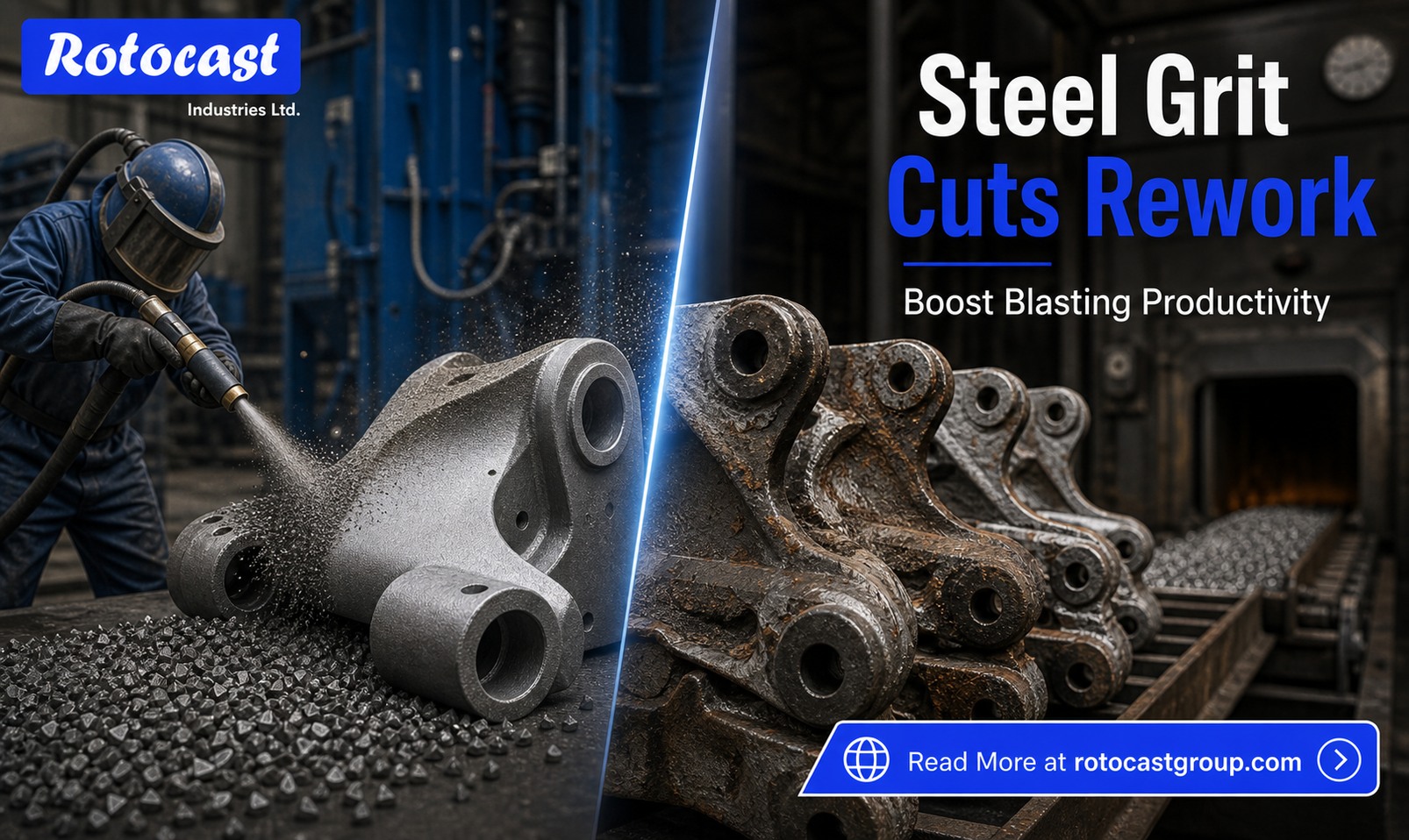
This is where Steel Grit can make a measurable operational difference. Its angular shape and cutting action allow it to attack tough contaminants, prepare coating-ready surfaces and reduce the need for repeated processing.
What Is Industrial Rework?
Industrial rework is any additional operation required to correct a component that did not meet the required quality standard during its first production cycle.
In blasting and surface preparation, rework commonly occurs when:
- Rust or mill scale remains after blasting.
- The required surface profile is not achieved.
- Cleaning is uneven across the component.
- Coatings peel, blister or fail prematurely.
- Castings require repeated finishing before inspection.
- Excessive contamination affects painting or bonding.
Rework does more than increase processing time. It also occupies equipment that should be handling new production, raises electricity consumption, accelerates machine wear and increases the cost per accepted component.
Why Steel Grit Performs Differently
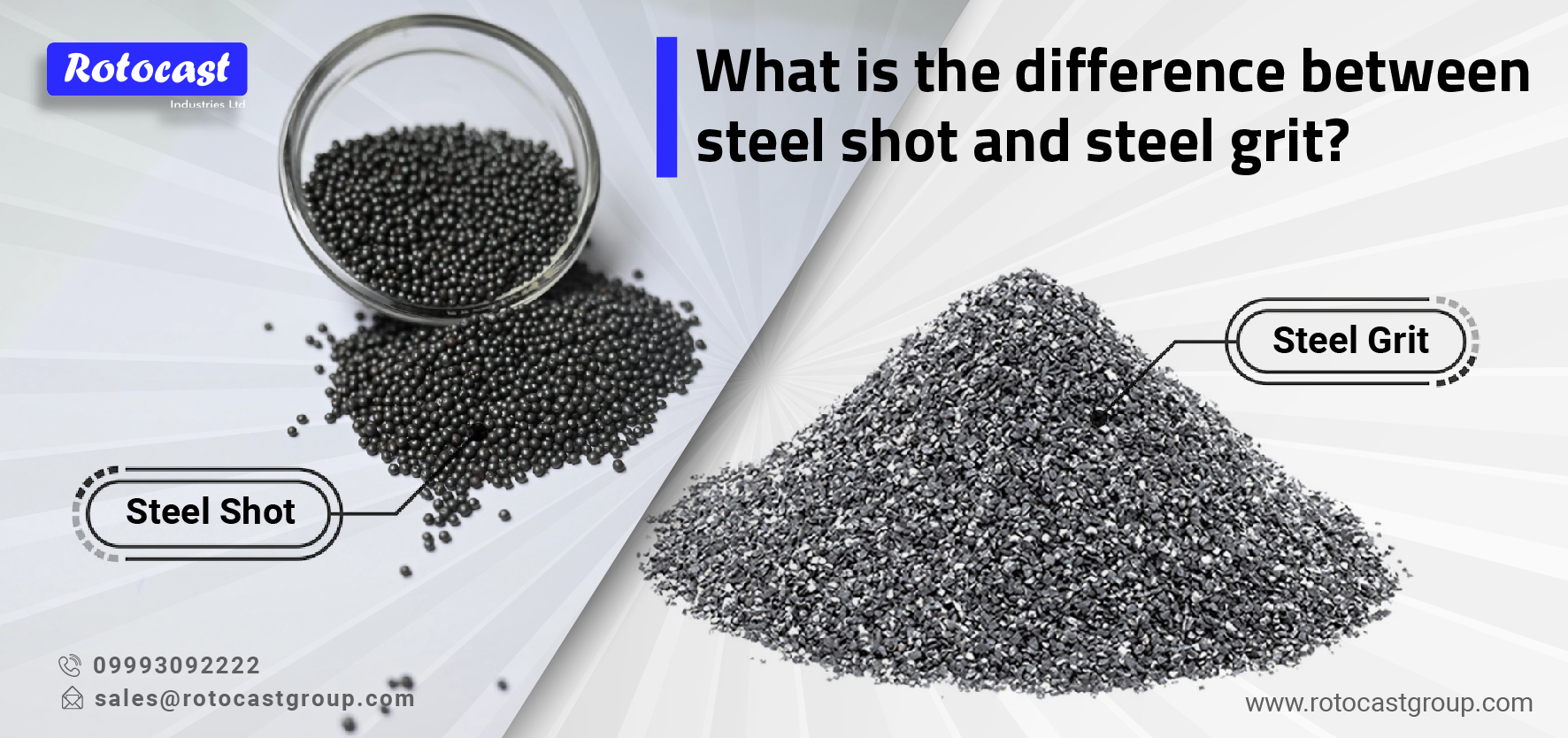
Unlike spherical media, steel grit has an angular structure with sharp cutting edges. These edges strike and scrape the metal surface, making the abrasive particularly effective for aggressive cleaning, descaling, deburring and profile generation.
The performance of Steel Grits depends on several factors:
- Grain size
- Hardness
- Shape consistency
- Toughness
- Cleanliness
- Breakdown rate
- Blasting velocity
When the grade is correctly matched with the application, steel grit removes difficult surface contaminants more efficiently and creates a predictable anchor profile for paint or protective coatings.
7 Ways Steel Grit Reduces Rework and Improves Productivity
1. It Removes Tough Scale More Effectively
Mill scale, baked-on sand, corrosion and old coatings can be difficult to remove with mild cleaning methods.
The sharp profile of steel grit provides a stronger cutting action. This helps expose clean metal faster and reduces the possibility of components failing visual or surface-cleanliness inspections.
Fewer failed inspections mean fewer parts returning to the blasting chamber.
2. It Reduces Repeat Blasting
Repeat blasting is one of the clearest signs of an inefficient surface-treatment process.
When abrasive media cannot achieve the required cleanliness or profile in one controlled cycle, the operator must process the component again. This creates:
- Longer turnaround time
- Higher electricity consumption
- Additional operator involvement
- Faster wear of blasting-machine components
- Lower daily production capacity
Properly selected steel grit improves first-pass cleaning and helps minimise avoidable reblasting.
3. It Creates a More Consistent Surface Profile
Coatings require more than a visually clean surface. They need a suitable anchor profile to bond effectively with the metal.
An inconsistent profile can lead to:
- Weak paint adhesion
- Blistering
- Peeling
- Early corrosion
- Premature coating failure
Steel grit produces controlled surface roughness when the correct grade, hardness and blasting parameters are used. This improves coating reliability and reduces downstream corrective work.
For a Steel Casting Foundry, better surface preparation can improve both the appearance and acceptance rate of finished cast components.
4. It Shortens Cleaning Cycles
The cutting action of steel grit can remove heavy contaminants within a controlled blasting cycle. Faster cleaning allows plants to process more components without necessarily increasing machine hours.
Shorter cycles can support:
- Greater component throughput
- Reduced queue time
- Better equipment utilisation
- Faster movement to painting or inspection
- Improved delivery performance
The objective is not simply to blast more aggressively. It is to achieve the required result using the most efficient combination of abrasive grade, machine settings and exposure time.
5. It Improves Coating Performance
Paint and protective coatings depend heavily on the condition of the underlying surface.
Even high-quality coatings may fail when applied over residual rust, dust, scale or an unsuitable profile. Steel grit helps produce a clean and appropriately textured surface that supports stronger mechanical bonding.
Improved coating adhesion reduces:
- Repainting
- Premature maintenance
- Customer complaints
- Product rejection
- Warranty-related costs
6. It Supports Repeatable Quality
Abrasive quality directly affects blasting consistency. Irregular grain sizes, excessive dust and unstable hardness can produce unpredictable results.
Working with an experienced Steel Grit Manufacturer in India helps manufacturers select media engineered for controlled hardness, sizing and durability.
Consistent abrasive quality makes it easier to standardise:
- Blast pressure
- Wheel speed
- Media flow
- Exposure time
- Surface-profile targets
- Inspection criteria
When the process becomes repeatable, quality depends less on correction and more on control.
7. It Increases Overall Plant Productivity
The productivity benefits of steel grit extend beyond the blasting area.
Cleaner components move faster into painting, coating, inspection, assembly and dispatch. Fewer rejected parts reduce congestion between production stages, while improved first-pass acceptance releases machine capacity for new work.
The result is a more efficient production flow with:
- Less rework
- Better machine utilisation
- Lower finishing costs
- More predictable output
- Improved delivery reliability
Steel Grit vs Steel Shot: Which Should You Use?
Steel grit and steel shot are both valuable industrial abrasive media, but they perform different functions.
Choose Steel Grit When You Need:
- Aggressive rust and scale removal
- Removal of old coatings
- A defined surface profile
- Strong coating adhesion
- Cleaning of heavy castings or fabricated structures
- Faster cutting action
Choose Steel Shot When You Need:
- Smoother and more uniform finishes
- Shot peening
- Reduced surface roughness
- Cleaning without an aggressive cutting profile
- Fatigue-strength improvement
- Controlled impact cleaning
Many plants use a carefully selected mix of Steel Shot and Steel Grit to balance cleaning speed, surface profile and finish consistency.
How to Select the Right Steel Grit Grade
Selecting the hardest or coarsest grit is not always the right answer. An overly aggressive abrasive may increase wear or produce a profile deeper than required.
Before finalising the grade, evaluate:
- Base material: Identify whether the component is cast iron, carbon steel, fabricated steel or another alloy.
- Contaminant type: Determine whether you are removing rust, paint, mill scale, sand or heat-treatment scale.
- Required surface profile: Match the grit size and hardness to the coating specification.
- Blasting equipment: Consider whether the operation uses air blasting, wheel blasting or another system.
- Component geometry: Complex shapes and recessed areas may require different media-flow characteristics.
- Current cycle time: Review whether long cycles are caused by the abrasive, machine settings or media contamination.
- Media consumption: Measure breakdown, carry-out and replenishment rates instead of evaluating abrasives only by purchase price.
- Dust generation: Excessive fines can reduce visibility, cleaning efficiency and machine performance.
A dependable Steel Abrasives Manufacturer can assess these variables and recommend a grade based on the actual operating environment.
Common Mistakes That Increase Rework
Even premium Steel Grit India products cannot deliver consistent results if the blasting process is poorly controlled.
Avoid these common mistakes:
- Using one grit grade for every application
- Ignoring media contamination
- Allowing excessive fines to remain in circulation
- Operating with worn blast wheels or nozzles
- Increasing pressure without analysing the surface requirement
- Skipping regular surface-profile measurements
- Overlooking abrasive breakdown and replenishment
- Delaying coating after blasting
- Choosing media only on initial price
The lowest-priced abrasive may become expensive when it causes higher consumption, longer cycle times or repeated processing.
Why Abrasive Quality Matters
Steel abrasive performance is shaped by hardness, microstructure, sizing accuracy, cleanliness and durability.
Rotocast manufactures Steel Shots and Steel Grits for demanding foundry, forging, automotive, construction and heavy-engineering applications. Controlled production and quality checks help users achieve reliable blasting performance and consistent surface preparation.
The goal is not simply to supply abrasive media. It is to help industrial plants optimise cleaning cycles, reduce avoidable rework and achieve better output from existing equipment.
Final Takeaway
Steel grit improves productivity because it addresses rework at its source: inconsistent surface preparation.
The correct grit can remove stubborn contaminants faster, develop the required surface profile, strengthen coating adhesion and improve first-pass acceptance. For industrial plants, that means fewer repeated cycles, lower finishing costs and more production capacity.
Better blasting is not about using more abrasive or applying more force. It is about selecting the right media and maintaining a controlled process.
Frequently Asked Questions
1. How does steel grit reduce industrial rework?
Steel grit removes rust, mill scale, old coatings and casting residue while generating a controlled surface profile. Better first-pass cleaning reduces repeat blasting, repainting and component rejection.
2. Is steel grit suitable for every blasting operation?
No. The correct abrasive depends on the material, contaminant, required finish, equipment and coating specification. Steel shot may be more suitable when a smoother finish or peening action is required.
3. Can steel grit improve coating adhesion?
Yes. Steel grit can create an anchor profile that helps paints and protective coatings bond mechanically with the prepared metal surface.
4. Does harder steel grit always improve productivity?
Not necessarily. Excessive hardness can increase machine wear or produce an overly aggressive profile. Productivity depends on selecting the correct hardness, size and operating parameters.
Need Help Selecting the Right Steel Grit?
Rotocast Industries Limited provides high-performance steel abrasive solutions for foundries, forging units, automotive manufacturers and heavy-engineering applications.