- Rotocast
- Sep 29, 2026
- Blogs, Shot Blasting, Steel Abrasives
- 0 Comments
Steel grit may look like a small part of an industrial operation, but its quality can directly influence surface cleanliness, coating adhesion, blasting time, equipment condition and production consistency.
When every batch performs predictably, operators can maintain stable blast parameters and achieve repeatable results. When grit quality changes from one batch to another, however, the blasting process becomes difficult to control.
Variations in hardness, particle size, angularity, density, durability or cleanliness can lead to uneven surface profiles and repeated processing. What initially appears to be a minor abrasive-quality issue may eventually result in rising costs, delayed dispatches and dissatisfied customers.
Understanding the consequences of inconsistent steel grit quality is therefore essential for every manufacturer, fabrication unit and Steel Casting Foundry seeking dependable surface-treatment performance.
Why Is Consistent Steel Grit Quality Important?
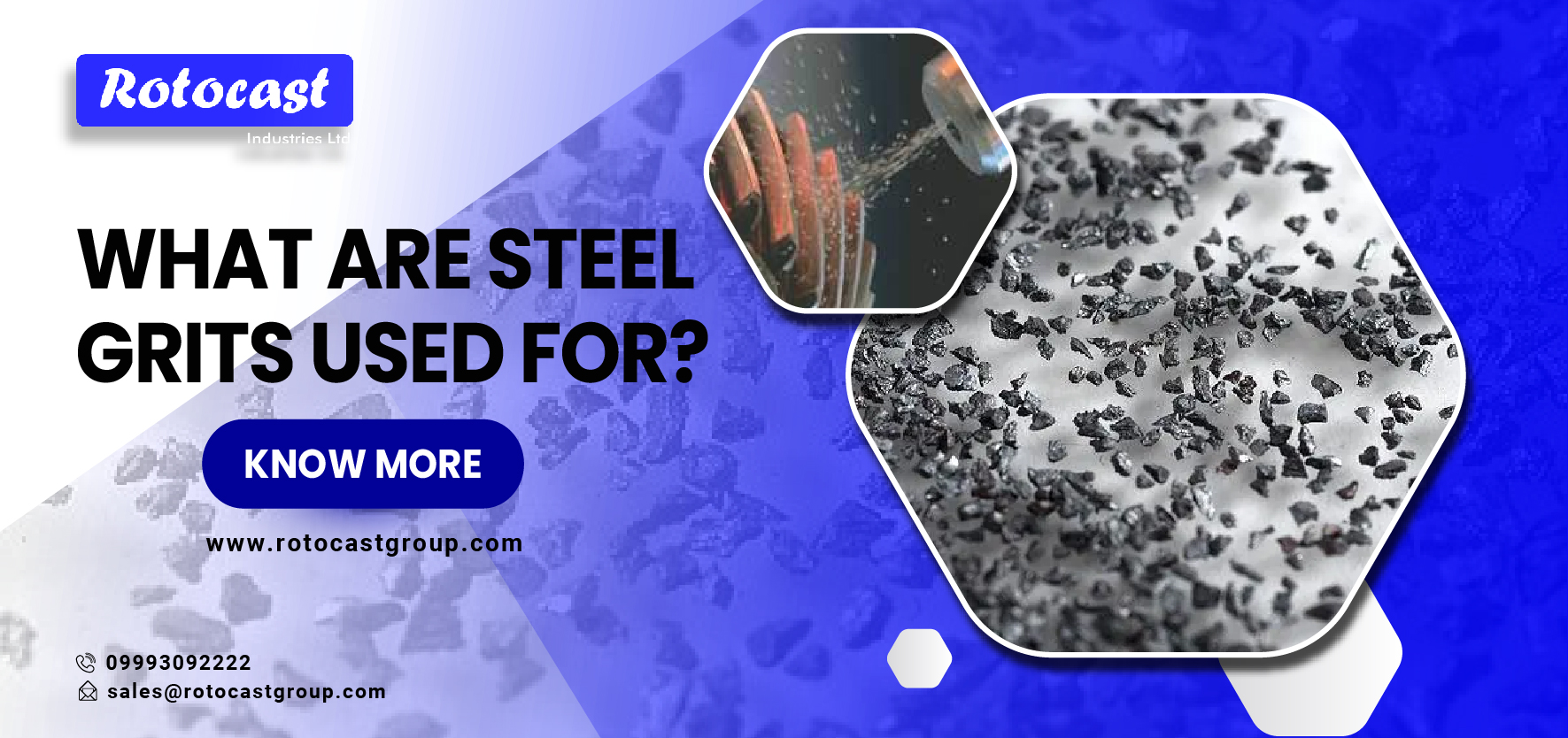
Steel Grit consists of angular metallic particles used for aggressive cleaning, descaling, coating removal and surface preparation.
Unlike spherical steel shot, the sharp edges of grit create a cutting action on the workpiece. The results depend significantly on several characteristics:
- Particle-size distribution
- Hardness level
- Shape and angularity
- Density and internal structure
- Resistance to premature fracture
- Chemical composition
- Cleanliness and contaminant levels
These properties determine how effectively the abrasive removes rust, mill scale, paint and other surface contaminants.
According to the general classification of steel abrasives, steel shot and steel grit are produced in different shapes, sizes and hardness levels for different applications. If these characteristics are not controlled, the results of the blasting process may also become unpredictable.
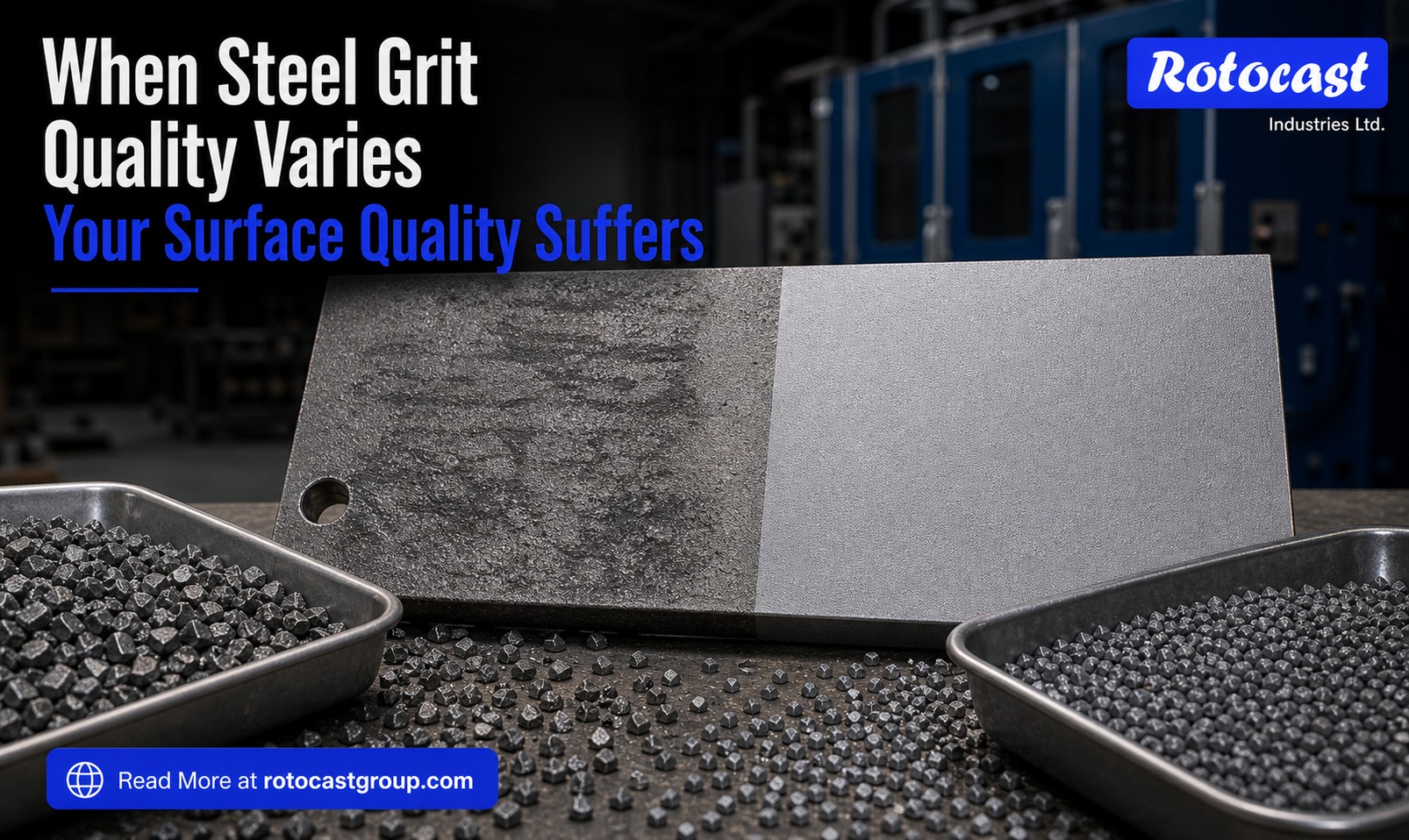
1. Uneven Surface Profiles
One of the first consequences of inconsistent steel grit is an irregular surface profile.
If a batch contains an uncontrolled mixture of coarse and fine particles, different areas of the workpiece may receive different levels of impact. Some areas may become excessively rough, while others may remain insufficiently prepared.
An uneven profile can create problems during painting, coating, bonding or metallising. The coating may adhere properly in one area but fail prematurely in another.
Manufacturers may observe:
- Patchy surface appearance
- Inconsistent roughness readings
- Visible blast patterns
- Areas requiring additional blasting
- Variations between successive production batches
A predictable grit-size distribution is therefore essential for achieving a uniform, coating-ready surface.
2. Higher Abrasive Consumption
High-quality steel grit is expected to survive multiple blasting cycles before gradually wearing down. Poorly manufactured or improperly heat-treated grit may fracture much earlier.
Premature fracture produces smaller particles that no longer deliver the required cutting action. These particles are removed by the separator system or become part of the dust load, forcing operators to add fresh abrasive more frequently.
The operation then consumes more material to process the same number of components.
Higher abrasive consumption affects:
- Cost per component
- Inventory requirements
- Procurement frequency
- Material-handling effort
- Waste collection and disposal
Selecting a dependable Steel Grit Manufacturer in India can help manufacturers obtain more consistent hardness, size and durability across successive supplies.
3. Longer Blasting Cycles
When grit loses its edges rapidly or contains too many undersized particles, it becomes less effective at removing scale, rust and old coatings.
Operators may compensate by increasing the blasting time. A component that should be cleaned in one controlled cycle may require another pass through the machine.
Longer cycle times can create a chain reaction across the plant:
- Fewer components are processed per hour.
- Work-in-progress begins to accumulate.
- Downstream painting or finishing operations have to wait.
- Energy consumption increases.
- Production schedules become difficult to maintain.
This is how an apparently inexpensive abrasive can become costly when evaluated on total process performance rather than its purchase price alone.
4. Increased Dust and Poor Visibility
Excessive dust is often a warning sign that grit is breaking down too quickly or that the working mix contains too many fines.
A high dust load can reduce visibility inside the blast cabinet and make it more difficult to monitor the cleaning process. It can also place additional pressure on dust-collection and separation systems.
The consequences may include:
- Frequent filter maintenance
- Reduced separator efficiency
- More housekeeping requirements
- Contamination of reusable abrasive
- Lower visibility during manual blasting
- Unnecessary stress on ventilation equipment
Consistent, durable Steel Grits support a more stable working mix and reduce the rapid formation of unusable fines.
5. Excessive Wear on Blasting Equipment
Inconsistent grit does not affect only the workpiece. It may also influence the wear rate of blasting equipment.
Oversized particles or grit with unsuitable hardness can accelerate wear on:
- Blast wheels
- Control cages
- Impellers
- Nozzles
- Liners
- Hoses
- Elevators and conveyors
Unplanned equipment wear increases spare-part consumption and maintenance downtime. If blast-wheel components wear unevenly, the media-delivery pattern may also change, creating further inconsistencies in surface preparation.
A reliable Steel Abrasives Manufacturer should help customers select an appropriate grit grade for their equipment, substrate and desired finish—not merely supply abrasive material.
6. Coating Adhesion Problems
The purpose of abrasive blasting is not limited to making a surface look clean. It also prepares the surface so that paint or another protective coating can bond effectively.
If inconsistent grit produces inadequate cleanliness or an unsuitable profile, the coating may not anchor correctly. Residual scale, contamination or irregular roughness can contribute to:
- Peeling
- Flaking
- Blistering
- Early corrosion
- Uneven coating thickness
- Premature coating failure
These problems may appear only after the component has been painted, inspected, delivered or installed. At that stage, corrective action becomes considerably more expensive than getting the blasting process right the first time.
7. More Rework and Rejected Components
Rework is among the most expensive consequences of inconsistent abrasive quality.
A component that fails surface inspection may need to be blasted again. If it has already been coated, the coating may have to be removed before the entire finishing process can restart.
Rework consumes:
- Additional abrasive media
- Operator time
- Machine capacity
- Electricity
- Paint or coating material
- Inspection resources
- Production-floor space
In severe cases, the component may be rejected entirely.
For industries managing large castings, structural components or high-volume production, even a small increase in rework can have a substantial operational impact.
8. Unpredictable Production Costs
The purchase price of grit represents only one part of the total blasting cost.
Manufacturers must also consider:
- Abrasive consumption per component
- Cleaning time per batch
- Energy used per cycle
- Equipment-maintenance requirements
- Labour involved in rework
- Dust-disposal costs
- Rejected or delayed components
- Coating failures and customer complaints
When steel grit quality varies, these costs become harder to forecast. Production managers may find that the same grade gives satisfactory results in one delivery but performs differently in the next.
Consistent quality allows plants to standardise their parameters and calculate a more reliable cost per cleaned component.
What Causes Steel Grit Quality to Vary?
Inconsistent performance may result from several manufacturing or handling issues.
1. Uncontrolled raw materials
Variations in chemical composition can affect hardness, toughness and resistance to fracture.
2. Improper heat treatment
Insufficiently controlled heat-treatment cycles can produce grit that is too brittle or too soft for the intended application.
3. Poor size classification
An excessive mixture of different particle sizes produces inconsistent impact energy and surface profiles.
4. Irregular particle shape
Grit that lacks controlled angularity may not deliver the expected cutting performance.
5. Internal defects
Porosity, cracks or structural weaknesses can cause particles to break down prematurely.
6. Contamination
Rust, foreign material, moisture, dust or manufacturing residue may interfere with blasting and surface cleanliness.
7. Inconsistent packaging and storage
Even well-manufactured grit can deteriorate when it is exposed to moisture or stored incorrectly.
Warning Signs of Poor Steel Grit Quality
Production teams should investigate grit quality when they notice:
- Abrasive consumption increasing without a process change
- Longer cleaning cycles
- Excessive dust in the blasting system
- Frequent adjustments to machine settings
- Irregular surface-profile measurements
- Rapid breakdown of the working mix
- Increased nozzle, liner or wheel wear
- More components failing surface inspection
- Paint or coating adhesion problems
- Significant performance differences between deliveries
These symptoms can also result from equipment settings or maintenance issues. Therefore, the complete process—including the abrasive, machine, workpiece and operator settings—should be reviewed systematically.
How to Maintain Consistent Blasting Performance
1. Choose the correct grit grade
Select the particle size and hardness according to the substrate, contamination level, equipment type and required surface profile.
A grade that is too aggressive may damage the surface or accelerate equipment wear. A grade that is too mild may increase cycle time.
2. Evaluate total cost, not only purchase price
Compare suppliers using measurable performance indicators such as:
- Abrasive consumption per component
- Cleaning speed
- Surface-profile consistency
- Dust generation
- Equipment wear
- Rework percentage
- Cost per acceptable finished component
3. Monitor the operating mix
The abrasive inside a blasting machine changes during use. Worn particles must be removed and fresh media added at a controlled rate to preserve a balanced working mix.
4. Inspect incoming material
Check each delivery for visible contamination, moisture, unusual particle distribution or packaging damage. Laboratory checks may also be used when required.
5. Standardise process parameters
Record blast-wheel speed, pressure, media flow, exposure time and other relevant settings. Standardisation makes it easier to identify whether a performance change originates from the abrasive or the machine.
6. Work with an experienced manufacturer
A reliable supplier should offer consistent production, quality checks, grade guidance and technical support. Choosing solely on the lowest quoted price may shift much larger costs into production, maintenance and rework.
Steel Grit vs Steel Shot: Why the Difference Matters
Grit and shot should not be treated as interchangeable media.
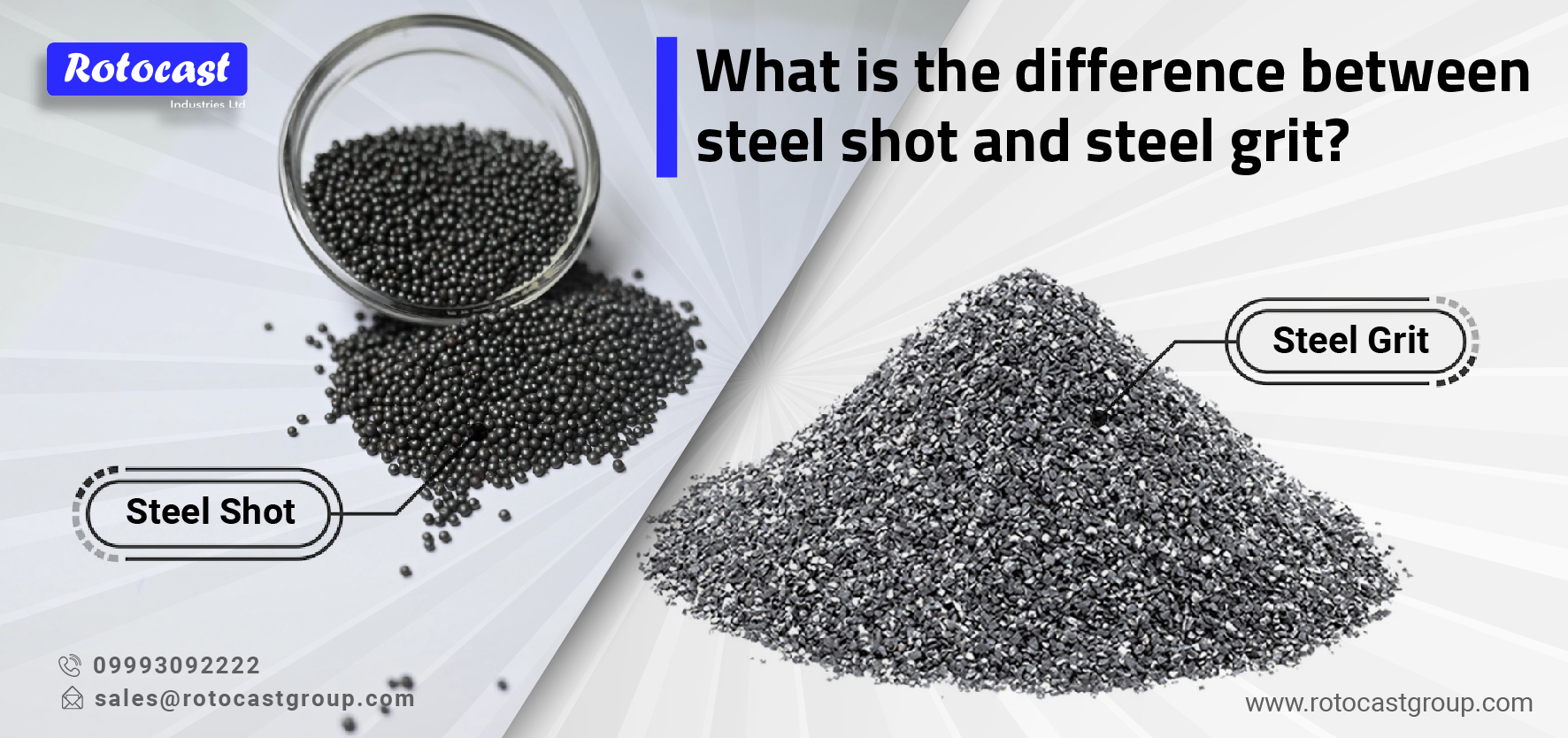
Steel grit has an angular shape and delivers a cutting action suited to aggressive cleaning, descaling and profile creation. Steel Shot has a more rounded shape and is commonly selected for cleaning, finishing and peening applications where a smoother result is required.
The correct choice depends on:
- The workpiece material
- Desired surface roughness
- Type of contaminant
- Coating specification
- Blasting equipment
- Required production rate
Using the correct abrasive is important, but obtaining that abrasive with consistent size, hardness and structure is equally critical.
Consistency Is a Productivity Tool
Reliable steel grit does more than clean a surface. It helps create a controlled and repeatable production process.
When abrasive quality remains consistent, manufacturers can achieve:
- Predictable surface profiles
- Stable blasting cycles
- Better coating preparation
- Lower abrasive consumption
- Reduced dust generation
- Fewer machine adjustments
- Less rework
- More dependable production planning
The real value of quality grit is therefore reflected in the performance of the complete operation—not simply in the price of each bag.
Frequently Asked Questions
1. What happens when steel grit size is inconsistent?
An uncontrolled mixture of coarse and fine particles can produce an uneven surface profile. Coarser particles may create excessive roughness, while finer particles may not remove contamination effectively.
2. Can poor-quality steel grit increase production costs?
Yes. Poor-quality grit may break down quickly, generate more dust, increase abrasive consumption, extend blasting cycles and create additional rework.
3. Why does low-quality steel grit produce more dust?
Grit with inadequate toughness or improper heat treatment may fracture prematurely. The broken particles become fines and dust that provide limited cleaning value.
4. Can steel grit quality affect paint adhesion?
Yes. If the grit does not achieve the required cleanliness and surface profile, paint or protective coatings may peel, blister or fail prematurely.
5. How can manufacturers check steel grit performance?
Manufacturers can monitor particle-size distribution, hardness, consumption rate, cleaning time, dust generation, surface-profile measurements and equipment wear.
6. Is the cheapest steel grit always more economical?
No. A lower purchase price can be offset by higher consumption, longer cycle times, maintenance requirements and rework. Cost per acceptable finished component is a more meaningful measure.
7. How should the correct steel grit grade be selected?
Selection should consider the workpiece material, contamination, required surface profile, blasting equipment, desired finish and production target.
Conclusion
Inconsistent steel grit quality can quietly affect every stage of surface preparation. It may produce uneven finishes, increase abrasive consumption, extend blasting cycles, accelerate equipment wear and create expensive coating failures.
Manufacturers should evaluate Steel Grit India suppliers on consistency, technical capability, manufacturing control and total operating value.
Rotocast Industries delivers high-performance steel abrasives designed to support dependable cleaning, surface preparation and industrial productivity. With controlled manufacturing and application-focused solutions, Rotocast helps businesses work towards consistent finishes, reduced rework and reliable performance across production batches.