- Rotocast
- Sep 7, 2026
- Blogs, Steel Abrasives, Surface Preparation
- 0 Comments
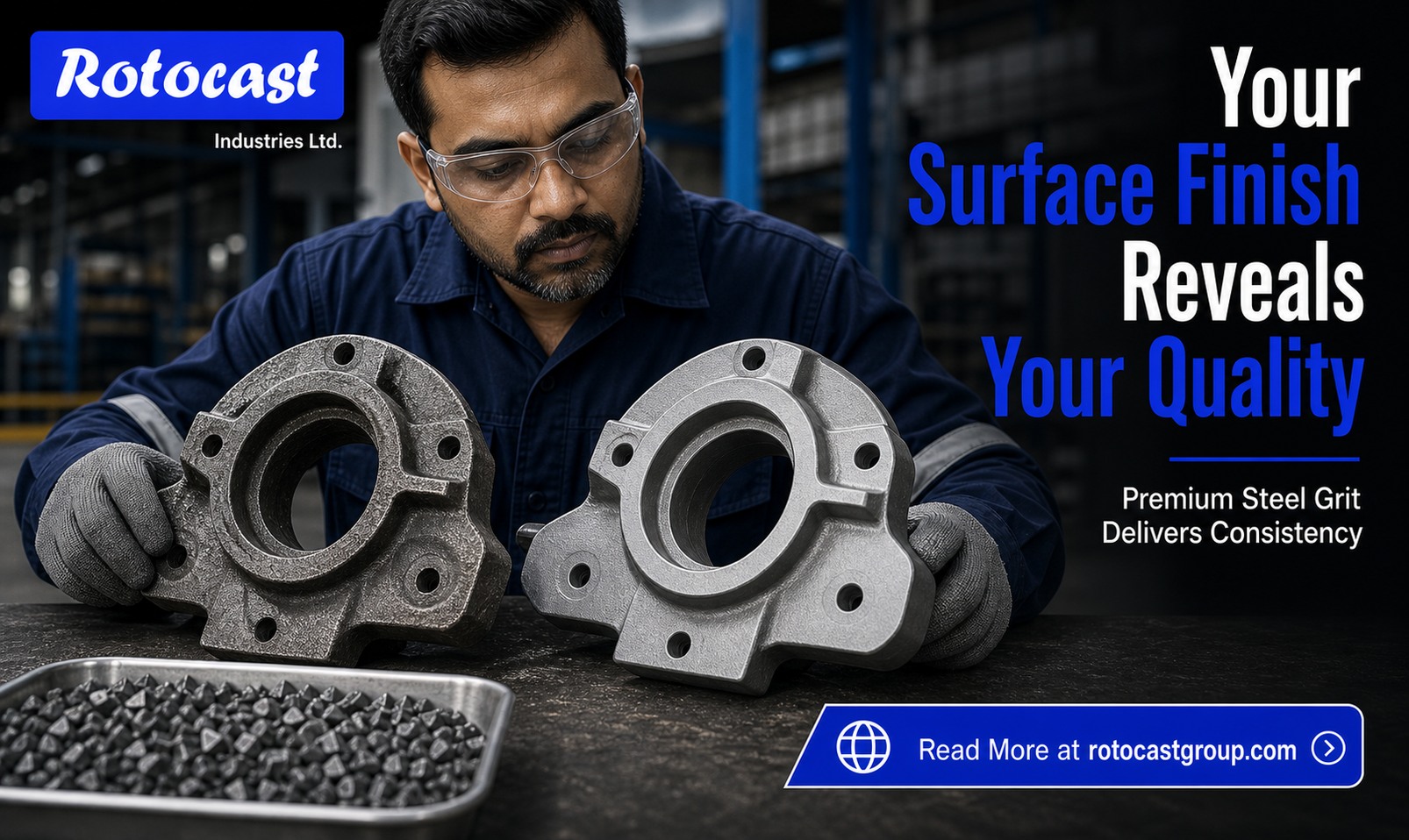
A metal component can pass through melting, casting, heat treatment, machining and inspection—but one of the first things a customer notices is still the surface.
That makes surface finish much more than a cosmetic detail.
For a manufacturing engineer, foundry manager or quality professional, the final surface can provide valuable clues about what happened earlier in the process. Uneven blasting, residual scale, excessive roughness, embedded contamination or inconsistent texture may indicate problems with abrasive selection, machine parameters, cleaning efficiency or process control.
In other words, your surface finish is often a visible record of your manufacturing discipline.
However, surface appearance alone cannot diagnose every metallurgical or dimensional defect. It should be treated as an important quality indicator alongside inspection, testing and process data.
Understanding what the surface is telling you can help identify problems before they become coating failures, rejected components, excessive rework or customer complaints.
Why Surface Finish Matters More Than Appearance
In engineering, surface finish describes characteristics such as roughness, waviness and the overall texture left by a manufacturing or finishing process. Surface finish
The required finish varies from one application to another.
A component that will be painted may need an appropriate anchor profile. A casting moving to machining must first be free from adhered sand and scale. A shot-peened component may require controlled coverage and impact consistency.
That is why manufacturers cannot simply ask:
“Does the component look clean?”
The better question is:
“Is the surface consistently prepared for what happens next?”
For foundries and fabrication plants, abrasive blasting using correctly selected Steel Shot and Steel Grit plays an important role in achieving that consistency.
Here are seven surface warning signs worth watching.
1. Patchy Cleaning Can Reveal Inconsistent Blast Coverage
Imagine inspecting a batch of castings after blasting.
One area looks clean and metallic. Another still contains scale or burnt-on residue. Corners appear different from broad surfaces.
That variation is telling you something.
Patchy cleaning can indicate:
- Inadequate blast coverage
- Incorrect exposure time
- Poor component positioning
- Worn blast-wheel components
- Uneven media distribution
- Incorrect abrasive size
- An unstable operating mix
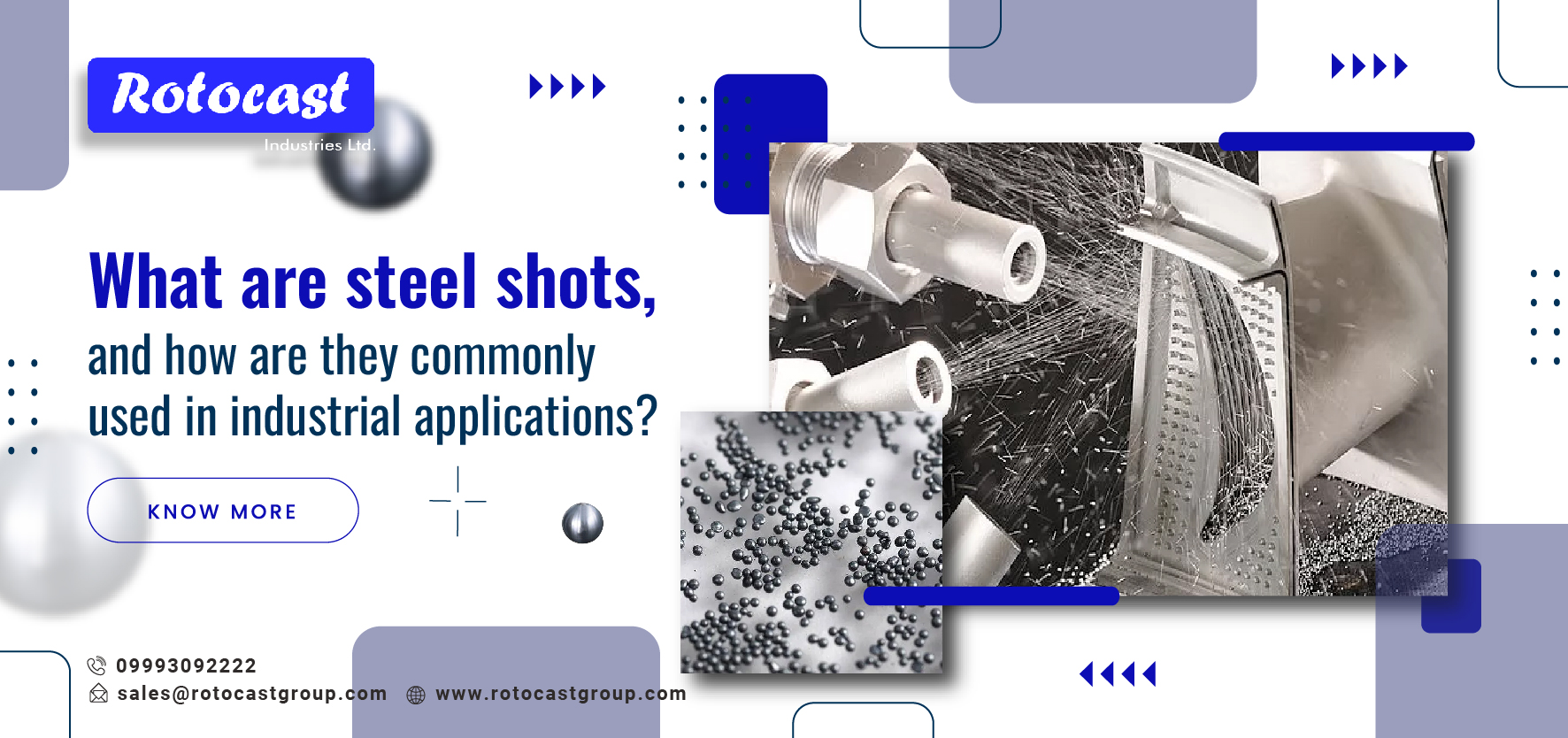
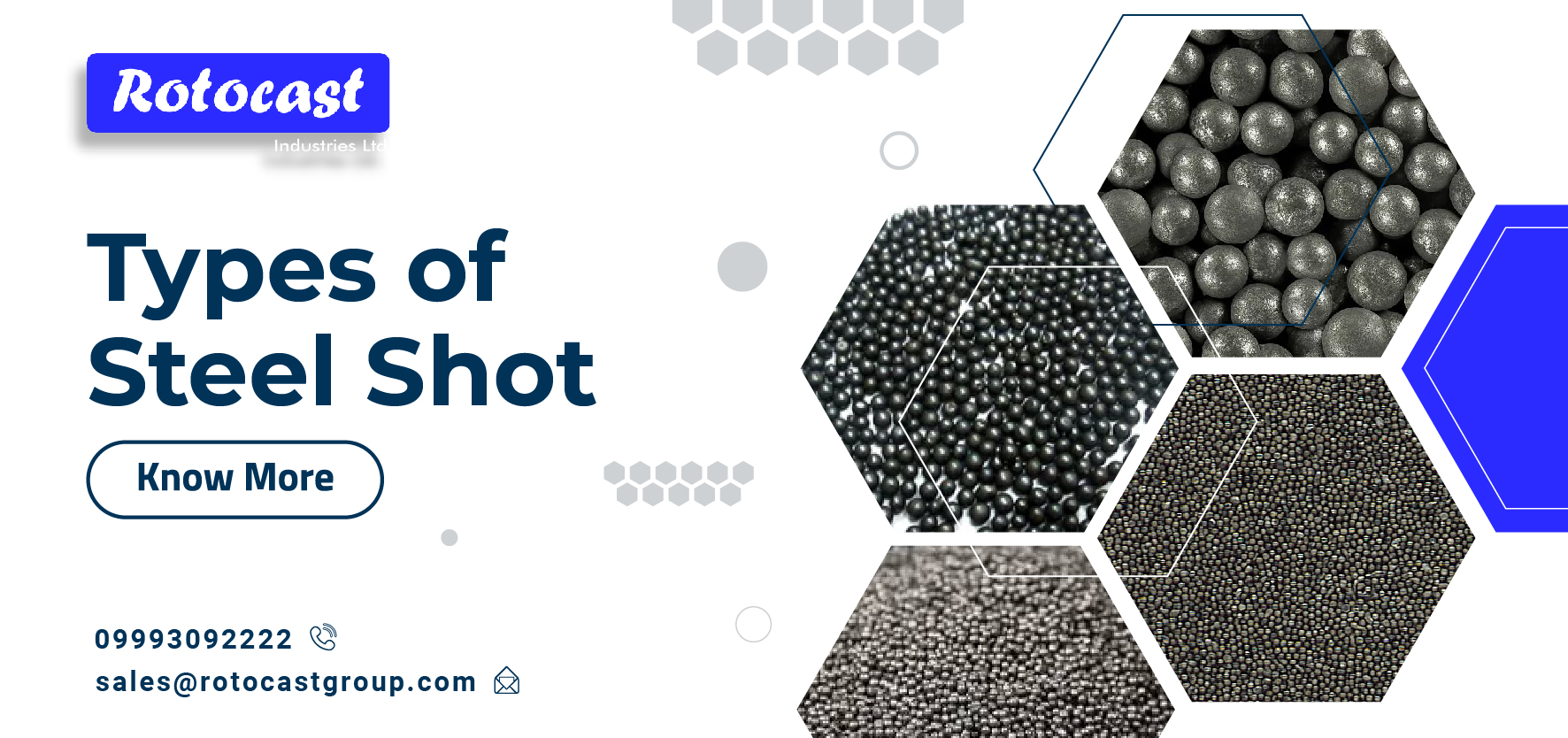
High-quality Steel Shot is spherical abrasive media commonly used for blasting, cleaning, surface preparation and shot peening. Rotocast states that its steel shot is produced with controlled spherical characteristics and is available for these industrial applications.
When shot size, hardness and machine parameters are appropriately matched to the application, the impact pattern can become more consistent across the component.
What the surface reveals:
Patchiness may mean your process is cleaning the component, but it is not cleaning it uniformly.
And inconsistency is often where rework starts.
2. Excessive Roughness May Mean Your Abrasive Is Too Aggressive
Rougher does not automatically mean better.
The optimum surface profile depends on what needs to happen after blasting.
If a surface is unnecessarily aggressive, potential problems can include:
- Excessive metal removal
- Poor cosmetic appearance
- Higher coating consumption
- Unwanted dimensional effects on sensitive parts
- Additional finishing requirements
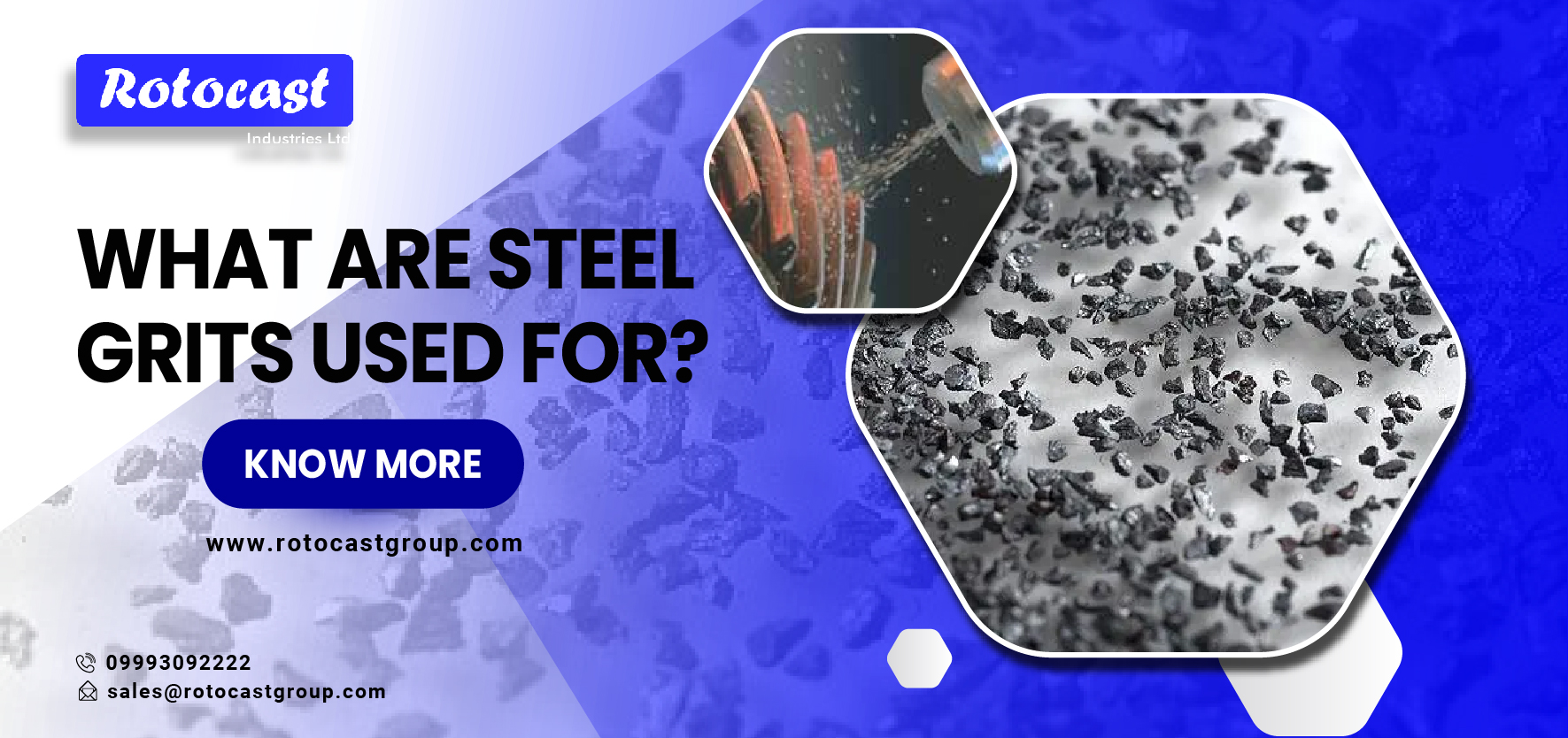
Angular Steel Grit provides a more cutting action and is particularly useful where rust, coatings or contaminants must be removed quickly or where a stronger surface profile is required. Rotocast offers different grit hardness ranges for varying applications.
The key is not to choose the most aggressive abrasive.
The key is to select the abrasive that creates the required surface condition.
What the surface reveals:
If parts routinely emerge rougher than specification, the media grade, hardness, size, blasting intensity or exposure time deserves investigation.
3. A Surface That Looks Clean but Fails Coating Can Reveal Poor Preparation
One of the most expensive surface problems may not be obvious immediately.
The part looks clean.
It gets painted.
It passes initial inspection.
Then the coating begins blistering, peeling or losing adhesion during service.
Why?
Because visible cleanliness and coating readiness are not always the same thing.
Effective surface preparation should address:
- Rust and scale removal
- Old coating residue
- Surface contamination
- Required surface profile
- Consistency across the component
Rotocast describes surface preparation as cleaning and surface roughening performed to support the adherence of paints and coatings, with abrasive selection influenced by the specified roughness requirement.
What the surface reveals:
Premature coating problems can indicate that the preparation stage delivered the wrong profile—or left contaminants behind—even when the component initially appeared acceptable.
This is why surface preparation should be treated as an engineered process rather than a cosmetic cleaning step.
4. Residual Sand and Scale on Castings Can Reveal Incomplete Foundry Cleaning
A freshly produced casting rarely leaves the mould ready for coating, machining or dispatch.
The surface may still carry:
- Adhered moulding sand
- Oxide scale
- Burnt-on material
- Surface residues
- Fins or other unwanted material
Within a Steel Casting Foundry, repeated residual contamination after cleaning may indicate that blasting parameters, abrasive selection, cycle time or part presentation require correction.
Rotocast’s own guidance notes that castings can carry sand, scale, oxidation and other residues after moulding and that these contaminants need removal before subsequent operations such as inspection, machining, painting or dispatch.
Abrasive blasting can make this stage considerably more repeatable than depending entirely on manual brushing, scraping or grinding.
What the surface reveals:
If residues repeatedly remain in recesses, pockets or difficult geometries, the problem may not be the casting itself—it may be the cleaning process surrounding it.
5. Uneven Texture Across Batches Can Reveal Abrasive Instability
Two components manufactured under the same specification should not look dramatically different after the same finishing process.
If one production batch appears smooth, another aggressive and another patchy, manufacturers should investigate the stability of the entire blasting process.
Abrasive media can influence:
- Impact energy
- Cleaning speed
- Surface profile
- Coverage
- Abrasive consumption
- Dust and fines generation
- Machine wear
When media varies excessively in size, hardness, shape or durability, predictable surface results become harder to maintain.
A dependable Steel Abrasives Manufacturer therefore needs to focus not only on supplying abrasive material but on consistency in the characteristics that influence blasting performance. Rotocast states that its production line follows controlled manufacturing and quality processes for steel shot and steel grit.
What the surface reveals:
Batch-to-batch variation can be a warning that you are managing symptoms at the machine while ignoring variation in the blasting media itself.
6. Repeated Reblasting Can Reveal a Process-Efficiency Problem
When operators routinely say, “Blast it once more,” the problem should not be considered normal production behaviour.
Repeated blasting consumes:
- Machine time
- Energy
- Abrasive media
- Labour
- Production capacity
- Component handling time
It can also accelerate wear on blast-wheel components and other machine parts.
Reblasting can result from unsuitable media, insufficient abrasive flow, incorrect cycle settings, worn equipment or an operating mix dominated by fines.
For procurement teams comparing Steel Shots India, Steel Grits India, Steel Shot India or Steel Grit India suppliers, the purchase price per kilogram should therefore not be the only criterion.
A lower-priced media that produces inconsistent cleaning, faster breakdown or repeated cycles can increase the real cost per finished component.
What the surface reveals:
If first-pass acceptance is low, your surface is effectively telling you that the manufacturing process is spending resources twice to achieve one acceptable result.
7. A Good-Looking Surface With Poor Repeatability Can Reveal Weak Process Control
This is perhaps the most important warning sign.
One component comes out perfectly.
The next one does not.
Operators compensate manually. Settings keep changing. Media additions are inconsistent. Quality depends too much on individual experience.
The surface may occasionally look excellent—but the process itself is not under adequate control.
Quality manufacturing is about repeatability.
A stable blasting operation should control factors including:
- Abrasive type – shot, grit or an engineered mix
- Abrasive size – selected according to cleaning and profile requirements
- Hardness – appropriate to the component and application
- Media condition – maintaining the correct operating mix
- Abrasive flow rate – enough media to produce uniform coverage
- Blast velocity – matched to the required impact energy
- Exposure time – sufficient without unnecessary overblasting
- Machine condition – wheels, blades, separators and dust-control systems must perform consistently
- Part presentation – surfaces must be exposed effectively to the blast stream
- Inspection criteria – operators need a measurable acceptance standard
The general principle of abrasive blasting is to propel abrasive media against a surface to clean, roughen or otherwise modify its condition. Steel Shot and Steel Grit
What the surface reveals:
A process that occasionally produces an excellent finish is not necessarily a quality process.
A process that repeatedly produces the specified finish is.
Steel Shot vs Steel Grit: What Does Your Required Finish Need?
Choosing between Steel Shot and Steel Grit should start with the desired surface outcome.
Choose Steel Shot When You Need:
- More uniform impact
- Smoother surface appearance
- Cleaning and descaling
- Controlled surface refinement
- Shot peening applications
- Reduced cutting action
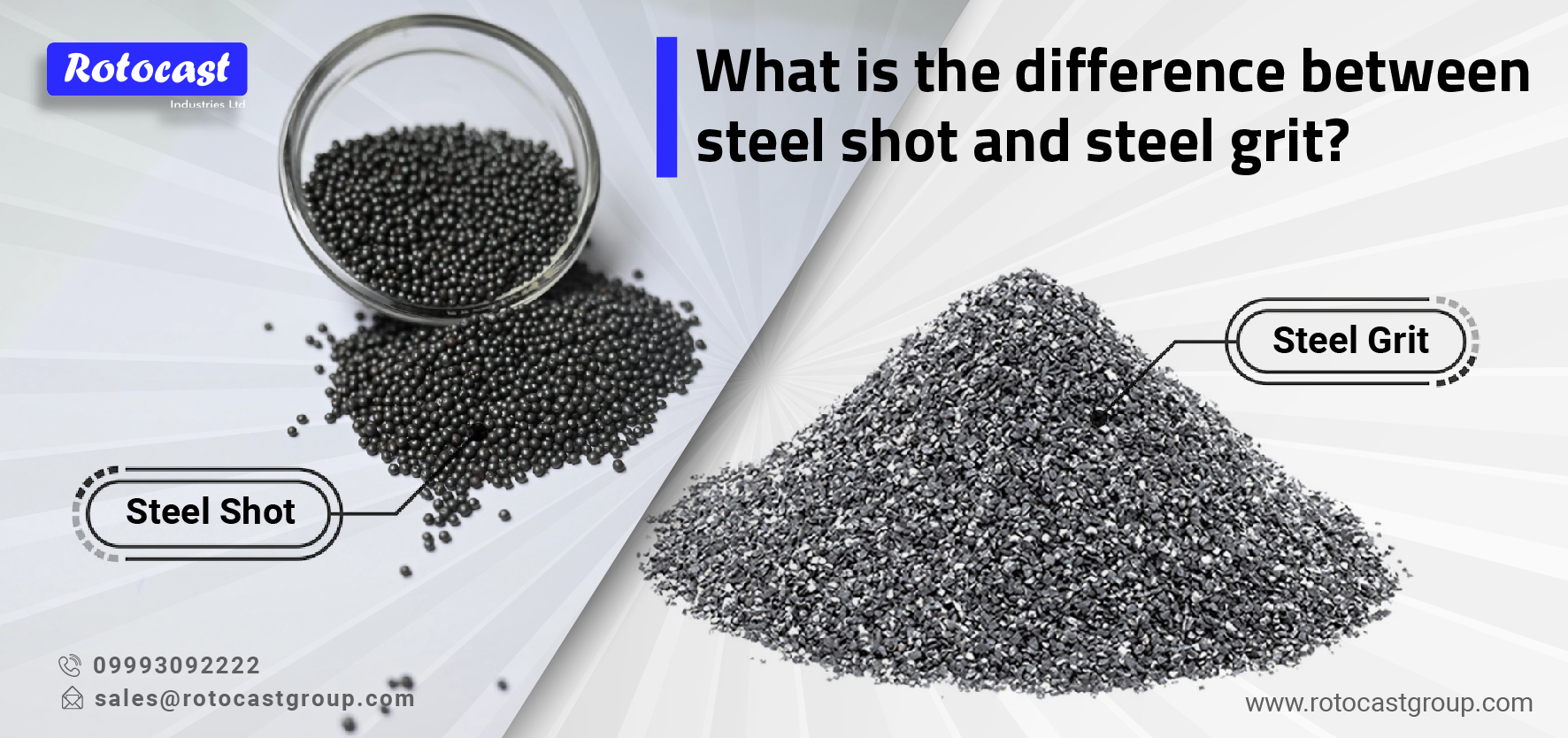
Steel Shots are spherical, which creates a different impact mechanism from angular grit.
Choose Steel Grit When You Need:
- More aggressive cleaning
- Faster scale or coating removal
- A stronger surface profile
- Increased cutting action
- Preparation for demanding coatings
Steel Grits are angular and therefore interact differently with the surface.
Neither abrasive is universally “better.”
The right selection depends on substrate, contamination, required profile, machine design and downstream finishing requirements.
What Procurement Teams Should Ask a Steel Shot Manufacturer
A manufacturer choosing a Steel Shot Manufacturer, Steel Grit Manufacturer or Shot Manufacturer in India should look beyond catalogue size and quotation value.
Ask:
- Is particle sizing controlled consistently?
- Is hardness suitable for my application?
- How stable is the abrasive during repeated cycles?
- Is the shape consistent with the intended blasting operation?
- Can the supplier recommend a grade based on my desired surface condition?
- Does the media work efficiently with my existing blast equipment?
- Can supply quality remain consistent from batch to batch?
These questions are equally relevant when evaluating a Steel Grit Manufacturer in India.
The objective is not simply to purchase abrasive.
It is to purchase predictable surface-performance capability.
Surface Finish Can Also Reveal Problems in Steel Casting
Surface quality begins before the blasting machine.
Within Steel Casting, manufacturing variables such as mould condition, pouring behaviour, solidification and subsequent processing can influence the final component condition.
This makes surface inspection valuable because some visible irregularities may originate earlier than the finishing process.
A capable manufacturing team therefore avoids automatically blaming the blasting machine for every surface issue.
Instead, it asks:
- Is the defect generated during casting?
- Is it caused during handling?
- Is cleaning incomplete?
- Is the abrasive unsuitable?
- Is the blast process unstable?
- Is machining creating the final irregularity?
- Is the coating exposing an earlier preparation issue?
That approach turns surface inspection into process intelligence rather than a simple pass/fail check.
The Real Cost of a Poor Surface Finish
Poor finishing quality affects more than appearance.
It can create costs through:
- Reblasting
- Repainting
- Additional grinding
- Coating failure
- Production delays
- Extra inspection
- Higher abrasive consumption
- Machine wear
- Rejected components
- Customer complaints
The visible defect is often only the final symptom.
The larger cost lies in the process inefficiency that produced it.
That is why manufacturers should track not only the final surface but also first-pass acceptance, abrasive consumption, blast-cycle time, machine condition and rework frequency.
How Rotocast Industries Ltd. Supports Consistent Surface Quality
Rotocast Industries Ltd. supplies steel abrasives for applications including surface preparation, surface blasting and shot peening, along with alloy steel casting solutions. The company lists Steel Shot and Steel Grit solutions across regular and premium abrasive ranges.
For manufacturers looking for a Steel Shot Manufacturer, Steel Grit Manufacturer or Steel Abrasives Manufacturer, the objective should be to choose media that helps make the process more predictable—not merely more aggressive.
Consistent abrasive characteristics combined with the correct blasting parameters can help manufacturers work toward cleaner surfaces, controlled profiles and repeatable finishing results.
Final Takeaway: Your Surface Is a Quality Report You Can See
A manufacturing process leaves clues.
Some are buried inside production reports.
Others are visible directly on the component.
Patchy cleaning, excessive roughness, contamination, inconsistent texture and repeated reblasting should never be dismissed as purely cosmetic issues. They can be early warning signs of problems with abrasive selection, machine condition, casting quality or process control.
The strongest manufacturing operations do not simply correct the defective surface.
They ask why the surface became defective in the first place.
Because when the same high-quality finish appears component after component, batch after batch, the surface is communicating something very different:
Your process is under control.
FAQ Section for SEO
1. What does surface finish indicate about manufacturing quality?
Surface finish can provide clues about cleaning consistency, abrasive selection, blast coverage, machining quality, coating readiness and overall process repeatability. It should be assessed alongside dimensional and material-quality inspections.
2. Is Steel Shot better for smooth surface finishing?
Steel Shot has a spherical shape and generally creates a more uniform impact pattern than angular Steel Grit. It is often selected where cleaning, controlled finishing or shot peening is required.
3. When should Steel Grit be used?
Steel Grit is commonly used when more aggressive cleaning, scale removal or a stronger surface profile is required before coating or other finishing operations.
4. Can poor blasting media cause coating failure?
Incorrect or inconsistent blasting media can contribute to inadequate cleaning or an unsuitable surface profile, which can negatively affect subsequent coating performance.
5. Why does the same blasting machine produce different finishes?
Possible causes include abrasive size variation, excessive fines, incorrect media mix, worn machine parts, different component positioning, inconsistent flow rate or changing cycle parameters.
6. What should manufacturers look for in a Steel Abrasives Manufacturer?
Manufacturers should evaluate consistency in abrasive size, shape, hardness, durability, quality control, technical support and suitability for the intended blasting application.